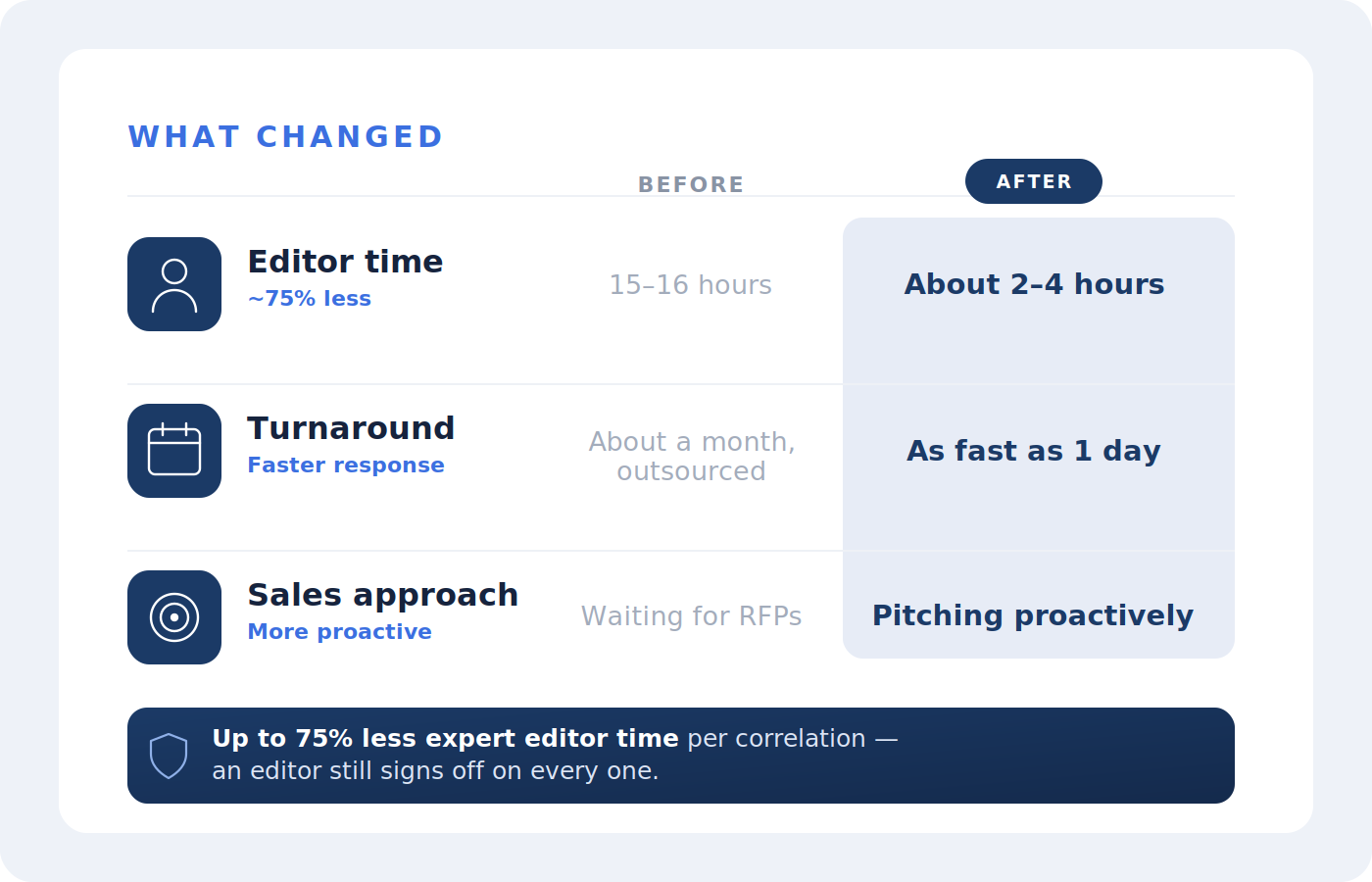
Standards correlation is one of the most time-consuming parts of selling into the US K-12 market. At Human Kinetics, a single correlation could take a senior editor up to two working days, while outsourcing it meant waiting up to a month. This is a look at how that changed after the publisher adopted Ludenso’s AI-powered correlation engine, and why its editors stayed central to the process.
Successful AI Applications in Practice. How Human Kinetics Solved State and District Correlations
By combining Ludenso's AI engine with editorial expertise, the publisher cut correlation time for state- and district standards by up to 75%, while supercharging human review.
The Publisher - Human Kinetics
Trusted K–12 Health Education. Nationwide Reach.
Human Kinetics has spent decades building one of the most respected K–12 health, physical education, and kinesiology catalogues in the United States. Its resources are trusted by schools and districts across the country, with standards alignment playing a central role in every adoption cycle.
The Bottleneck
A Workflow That Couldn’t Keep Up.
Like every publisher selling into the US K–12 market, its titles need standards correlations before they will even be considered. As Brad Hauser, Senior Administrator for Academic Sales, puts it, “The standards are the price of entry to even be considered.”
The challenge is that those standards are constantly changing. States adopt, adapt, and update them on different timelines, while larger districts often add their own requirements. A single grade span can include around 70 standards, and Human Kinetics produces 30 to 40 correlation documents each year across its K–12 catalog.
Standards correlation isn’t just time-consuming. It’s expert work. “It’s a required task that we have to do multiple times a year, and it’s a repetitive task,” says Drew Tyler, Senior Academic Acquisitions Editor and chair of the company’s AI task force. Even for Bethany Bentley, the acquisitions editor responsible for Live Well, producing a careful correlation took 15 to 16 hours.
Outsourcing wasn’t much better. A completed correlation typically took up to a month to come back before the editorial team could begin its review.
The challenge is that those standards are constantly changing. States adopt, adapt, and update them on different timelines, while larger districts often add their own requirements. A single grade span can include around 70 standards, and Human Kinetics produces 30 to 40 correlation documents each year across its K–12 catalog.
Standards correlation isn’t just time-consuming. It’s expert work. “It’s a required task that we have to do multiple times a year, and it’s a repetitive task,” says Drew Tyler, Senior Academic Acquisitions Editor and chair of the company’s AI task force. Even for Bethany Bentley, the acquisitions editor responsible for Live Well, producing a careful correlation took 15 to 16 hours.
Outsourcing wasn’t much better. A completed correlation typically took up to a month to come back before the editorial team could begin its review.
“It was always a little nerve-wracking. We have a pretty small pool of individuals we trust to do the work.”
Brad Hauser
Senior Administrator for Academic Sales
Human Kinetics
Human Kinetics
The Evaluation
Why Generic AI Wasn’t Enough
Human Kinetics didn’t jump straight to an external solution. Its AI task force first tested whether the problem could be solved safely and effectively with the tools already available inside the company.
“We realized that building a robust, purpose-built solution in-house was not the most sustainable path forward, so we chose to pivot and explore dedicated external solutions instead” Drew says.
The problem wasn’t unique to them. Eirik Wahlstrøm, Ludenso’s co-founder and CEO, says the pattern is almost universal. “Most of our current partners have tried solving this with generalized AI before, and figured out it doesn’t work too well. It’s inconsistent, you get hallucinations, the overall quality is not meeting the expected standards.”
His answer was a purpose-built system: build the structure around the expert knowledge the work depends on, and use AI only for the narrow steps where it adds value, working “to reduce the black box that is AI to its smallest component.” He is candid that it was harder than expected.
“We realized that building a robust, purpose-built solution in-house was not the most sustainable path forward, so we chose to pivot and explore dedicated external solutions instead” Drew says.
The problem wasn’t unique to them. Eirik Wahlstrøm, Ludenso’s co-founder and CEO, says the pattern is almost universal. “Most of our current partners have tried solving this with generalized AI before, and figured out it doesn’t work too well. It’s inconsistent, you get hallucinations, the overall quality is not meeting the expected standards.”
His answer was a purpose-built system: build the structure around the expert knowledge the work depends on, and use AI only for the narrow steps where it adds value, working “to reduce the black box that is AI to its smallest component.” He is candid that it was harder than expected.

“I completely underestimated the task early on. We spent months just getting to a level comparable to an external reviewer, and then months more to get it comparable to a human expert, and now in some cases better."
Eirik Wahlstrøm
Co-Founder and CEO
Ludenso
Ludenso
The Requirements
Protecting the Content
For Human Kinetics, the conversation wasn’t just about quality. It was also about protecting its content.
“We don’t allow any unlicensed use of our content for training AI models.”
Drew Tyler
Senior Academic Acquisitions Editor
Human Kinetics
Human Kinetics
Those requirements shaped how Ludenso built the platform:
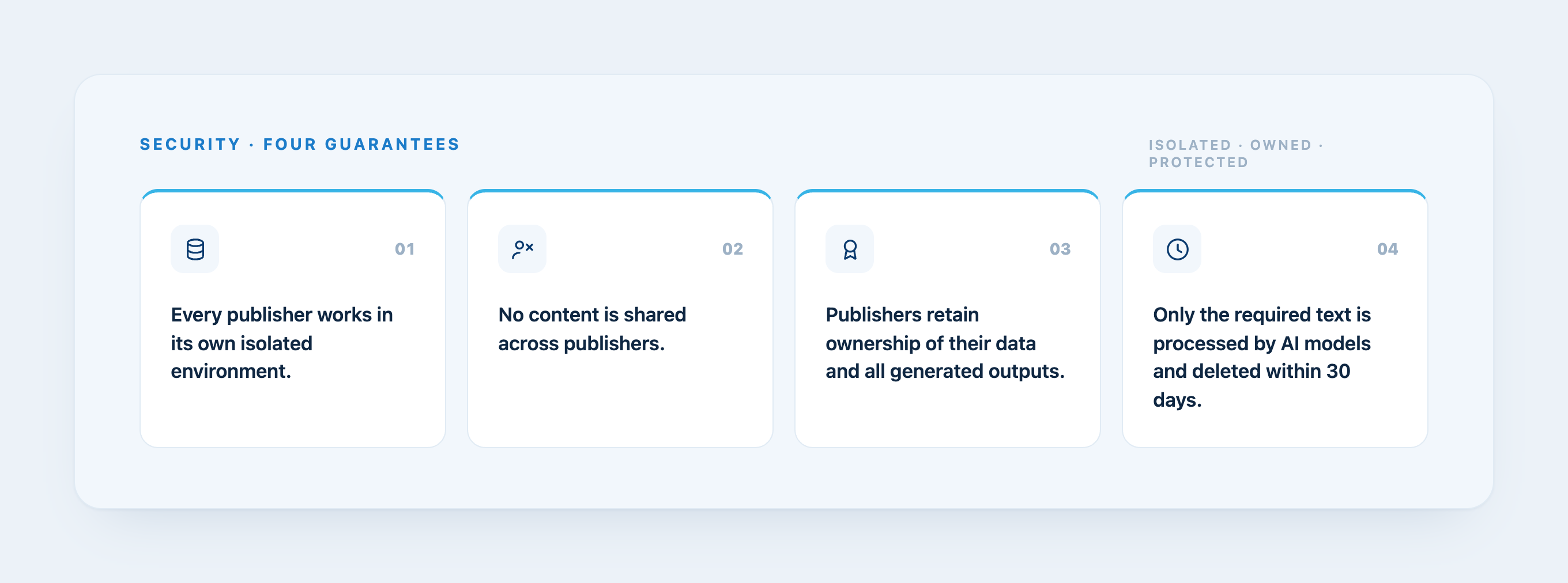
For Human Kinetics, those safeguards were what made the partnership possible in the first place.
The Workflow
Editors Stay in Control
The workflow is designed to keep editors in control. Ludenso’s correlation engine completes the initial mapping, and the editor responsible for the content reviews it before signing it off.
For Live Well, that editor is Bethany Bentley. Her editorial judgment remains the final authority, but instead of building every correlation from scratch, she reviews, refines, and approves the engine’s output.
On Ludenso’s side, she works closely with Benjamin Kjær, Product Director, who has led much of the development of the correlation engine and has become deeply familiar with Human Kinetics’ content through the collaboration.
For Live Well, that editor is Bethany Bentley. Her editorial judgment remains the final authority, but instead of building every correlation from scratch, she reviews, refines, and approves the engine’s output.
On Ludenso’s side, she works closely with Benjamin Kjær, Product Director, who has led much of the development of the correlation engine and has become deeply familiar with Human Kinetics’ content through the collaboration.
The Results
The Time It Gives Back
A correlation that used to take Bethany the better part of two working days now comes together in about four hours. “We were able to cut that time down to just a couple hours,” she says. “Benjamin did a little bit on his end, I did some checking on mine, and we got everything wrapped up in about four hours.” That is a saving of roughly 70 to 75 percent over building each correlation from scratch.
.png)
Just as importantly, the time saved hasn’t simply moved into review. Checking a Ludenso-generated correlation still takes Bethany around two to four hours, similar to reviewing a freelancer’s work today, and she expects that number to fall as the AI continues to improve. “I imagine the time we spend on Ludenso’s reports will get less and less as time goes on.”
Under Pressure
The Christmas Deadline
The biggest proof came over Christmas.
Human Kinetics received a large opportunity with a two-week deadline, leaving the team with effectively one working day after the holidays. Under the old process, it simply wouldn’t have happened.
“It would have been impossible for them to even find a subject matter expert, coordinate with them, and get this done,” Eirik says.
Because the workflow was already in place, Ludenso mapped the new set of standards while the team was away. When they returned, the completed correlations were ready for review.
For Brad, the bigger surprise wasn’t just meeting the deadline. It was having a comprehensive standards correlation the team had never realistically expected to produce in the first place. “Just having that in our back pocket to respond when it comes up is great.”
For Eirik, the project captured what the technology makes possible.
Human Kinetics received a large opportunity with a two-week deadline, leaving the team with effectively one working day after the holidays. Under the old process, it simply wouldn’t have happened.
“It would have been impossible for them to even find a subject matter expert, coordinate with them, and get this done,” Eirik says.
Because the workflow was already in place, Ludenso mapped the new set of standards while the team was away. When they returned, the completed correlations were ready for review.
For Brad, the bigger surprise wasn’t just meeting the deadline. It was having a comprehensive standards correlation the team had never realistically expected to produce in the first place. “Just having that in our back pocket to respond when it comes up is great.”
For Eirik, the project captured what the technology makes possible.
“We took the lead time down from what would have been a one-month process to one day, and enabled them to compete in a big offer.”
Eirik Wahlstrøm
Co-founder and CEO
Ludenso
Ludenso
The sales effect runs further than one bid. Human Kinetics always competed for the largest adoptions but had to let mid-size opportunities go. Faster correlation lets it show up to more of them.
The Partnership
An Extension of the Editorial Team
What both editors kept coming back to wasn’t just the technology. It was the collaboration.
Human Kinetics approached the project as more than a software implementation. The editorial team stayed closely involved throughout, bringing years of standards expertise into the process and helping refine the workflow as the collaboration evolved.
On Ludenso’s side, Benjamin Kjær, Product Director, became the bridge between the technology and Human Kinetics’ editorial team. As one of the people leading the development of the correlation engine, he became deeply familiar with the publisher’s content and editorial expectations, allowing feedback to be quickly discussed, understood, and reflected in the product.
“Sometimes he even knows about the issues before we’ve said it,” Bethany says.
For Brad, who had spent years coordinating freelance correlators, the difference was immediately noticeable: “It didn’t feel like we’d sent it off to some faceless company. It definitely felt like a collaborative process that I really appreciated.”
Human Kinetics approached the project as more than a software implementation. The editorial team stayed closely involved throughout, bringing years of standards expertise into the process and helping refine the workflow as the collaboration evolved.
On Ludenso’s side, Benjamin Kjær, Product Director, became the bridge between the technology and Human Kinetics’ editorial team. As one of the people leading the development of the correlation engine, he became deeply familiar with the publisher’s content and editorial expectations, allowing feedback to be quickly discussed, understood, and reflected in the product.
“Sometimes he even knows about the issues before we’ve said it,” Bethany says.
For Brad, who had spent years coordinating freelance correlators, the difference was immediately noticeable: “It didn’t feel like we’d sent it off to some faceless company. It definitely felt like a collaborative process that I really appreciated.”
The Upside
A Benefit They Didn’t Anticipate
The project had another unexpected outcome. Working closely with an external AI partner forced Human Kinetics to explain parts of its editorial process that had never been formally documented.
“A lot of this knowledge is held tacitly. People just kind of know. Working together helps us be more explicit about what we expect, both from a quality and a workflow perspective.”
Paul Ayers
Instructional Designer
Human Kinetics
Human Kinetics
The conversations that shaped the tool also helped Human Kinetics better define its own processes, creating value beyond the correlations themselves.
The Bigger Picture
More Opportunities, Not Just Faster Work
Asked whether she’d ever want to go back to building correlations by hand, Bethany doesn’t hesitate.
“I would prefer never to do them from scratch ever again.”
Bethany Bentley
Acquisitions Editor
Human Kinetics
Human Kinetics
That reaction says as much about the workflow as it does the time savings. It reflects a fundamental shift in what the team now has the capacity to do.
“We are historically doing 30 a year,” Drew says. “But now all of a sudden we can do 50 or more.”
Instead of deciding which opportunities they have time to pursue, Human Kinetics can now respond to far more of them. Brad has already seen that change on the sales side. “We feel confident that we can respond to those opportunities in the moment.”
The team is careful not to overstate the commercial impact. Adoption cycles can run for years, so it will take time before they can directly connect new business to the change. “It’ll be a while before we have hard data to say this got us this win. But even just being able to make our submission is great.”
The biggest change, though, is that capacity is no longer the limiting factor.
“We are historically doing 30 a year,” Drew says. “But now all of a sudden we can do 50 or more.”
Instead of deciding which opportunities they have time to pursue, Human Kinetics can now respond to far more of them. Brad has already seen that change on the sales side. “We feel confident that we can respond to those opportunities in the moment.”
The team is careful not to overstate the commercial impact. Adoption cycles can run for years, so it will take time before they can directly connect new business to the change. “It’ll be a while before we have hard data to say this got us this win. But even just being able to make our submission is great.”
The biggest change, though, is that capacity is no longer the limiting factor.
“It just really lets us be proactive. We could do correlations for all 50 states for all of our products if we wanted to.”
Bethany Bentley
Acquisitions Editor
Human Kinetics
Human Kinetics
Want to See What This Could Look Like for Your Workflow?
Get in touch