An interview series from Ludenso
In this series, Ludenso speaks with people shaping the future of educational publishing.
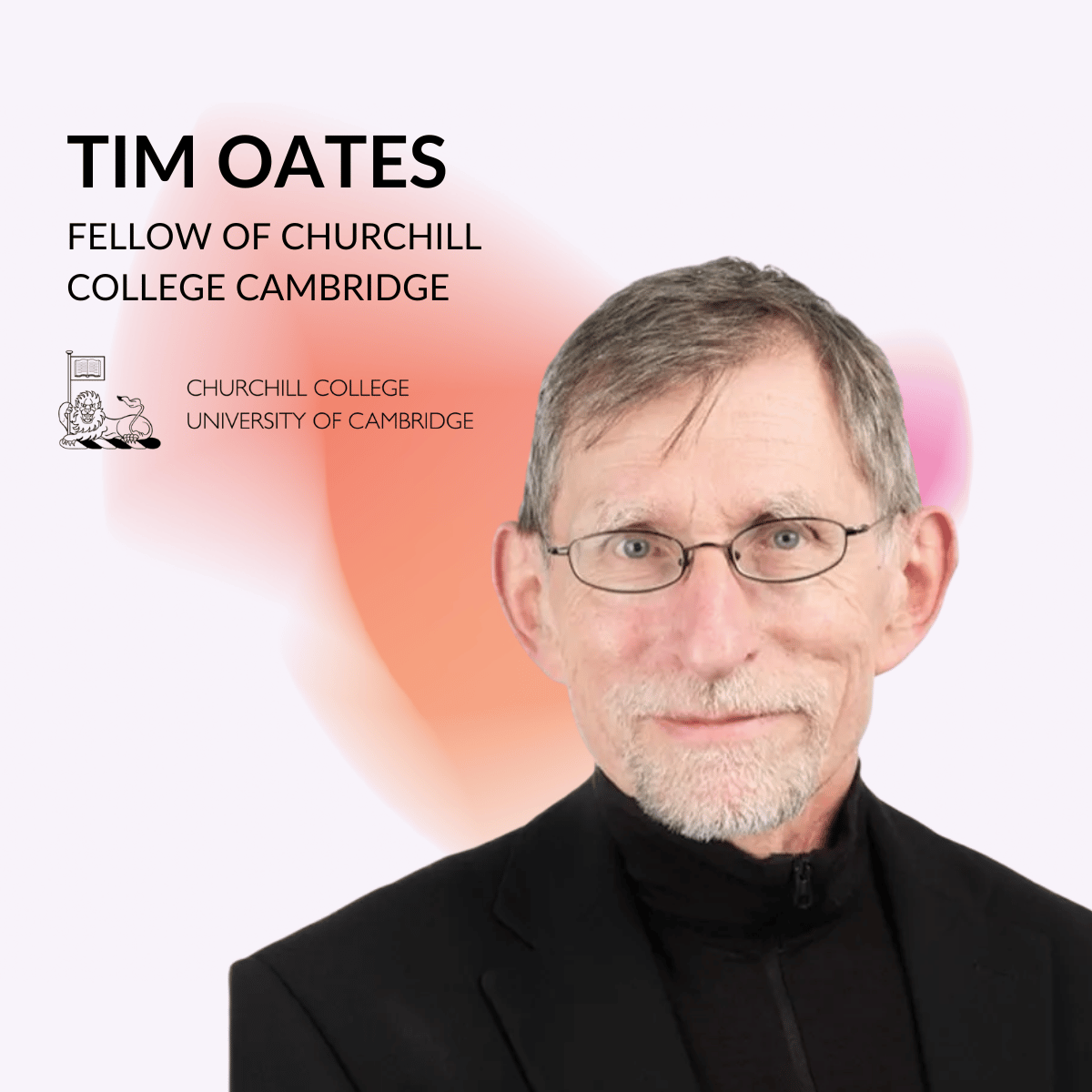
After the conversation with Jonathan Viner, this edition features a perspective from one of the most rigorous and respected voices in curriculum and assessment research: Tim Oates CBE.
Tim is a Fellow of Churchill College Cambridge, where he works on the performance of education systems, particularly on how national curriculum and assessment arrangements shape learning outcomes.
Until 2025, he was Group Director of Assessment Research and Development at Cambridge Assessment, where he led a team of 70 researchers and built an international reputation for evidence-based curriculum work. Ludenso began working with Tim and Cambridge back in 2022, and in 2025 that relationship deepened into a formal research project on Cambridge textbooks coupled with Ludenso's AI. (This project is now led by Sylvia Vitello, PhD.)

Tim has advised the UK government and other national and international bodies on curriculum and assessment policy, chaired the expert panel for the 2010 review of the National Curriculum in England, and published influential work on curriculum and educational improvement. His recent projects include designing a new statutory assessment framework for Northern Ireland and developing curriculum goals for Flanders. He was awarded a CBE (Commander of the Order of the British Empire) for services to education in 2015.
Tim combines deep theoretical grounding in cognitive science with hands-on policy work. That makes him one of the few people who can move fluently between neuroscience, classroom practice, and government reform.
He often makes connections that others miss. Grab a coffee and learn something new.
Tim's work keeps returning to the same core insight: that people routinely confuse access to knowledge with acquiring knowledge. In a time where several AI companies promise to put all human knowledge at a learner's fingertips, that distinction is commercially critical for publishers to understand.
The promise of AI is often framed as giving learners access to all human knowledge. Tim's pushback is immediate:
"Access to knowledge is not enough. It's how you acquire it and build it, how you integrate it and what you then do with it that's fundamental."
And what that construction looks like differs significantly by subject. In biology or mathematics, there are right and wrong answers. Understanding the principles and formulas is non-negotiable. In literature or music, creativity and the novel combination of ideas are central to the discipline itself. The scaffolding required is fundamentally different.
Publishers who understand those distinctions are designing for the full range of what learning demands: long-term memory, skills, and creativity. Today, the hard part is not access to information, it is how to support learners in constructing their own knowledge.
One of Tim's most emphatic positions is that the idea of "outsourcing" memory to technology is scientifically wrong. Working memory has hard limits, and genuine expert performance depends on complex integrations of knowledge stored in long-term memory; knowledge that can be pulled down rapidly when needed.
"Human memory is just so important. And so the idea that we do not have to remember things, which I still hear frequently said, is just scientifically incorrect in terms of human performance. Your personality, your characteristics, your capabilities are heavily determined by what you hold in long-term memory.” Tim says.
Any product that erodes that process is not a learning product. It is a liability.
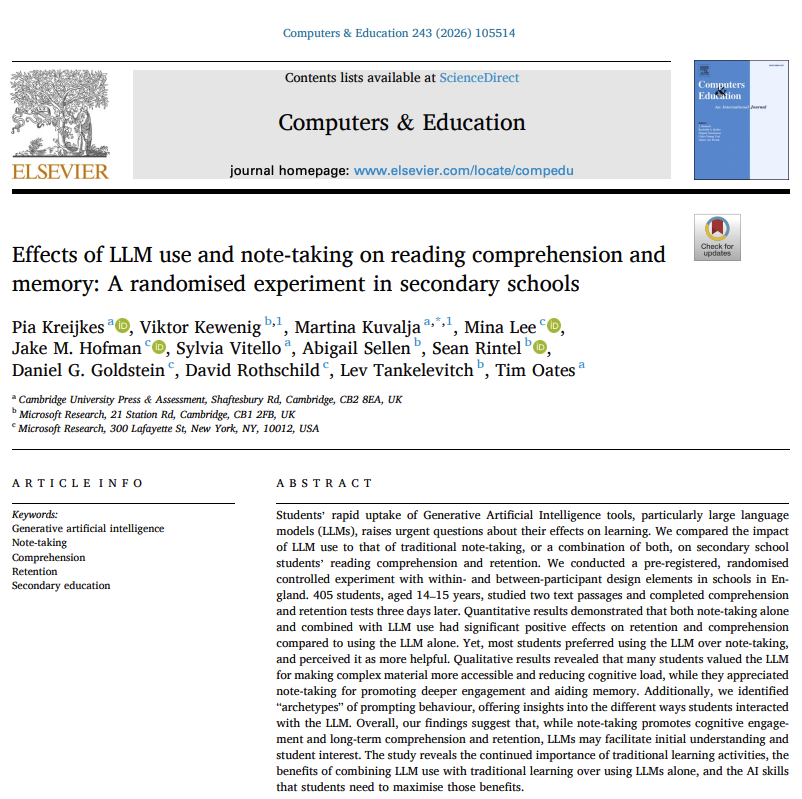
Cambridge and Microsoft Research set out to answer a deceptively simple question: how does note-taking compare to using an LLM as a strategy for learning? In a tightly controlled study (Cambridge blog), Tim, Pia Kreijkes, Sylvia Vitello, and several other experts found that 405 teenagers who used ChatGPT enjoyed the task more and were more likely to repeat it. However, they retained less than those who took notes as part of understanding the key ideas and content in the text.
When Microsoft researchers pointed out that students had followed fascinating tangents, Tim and his team were unmoved:
"Yes, but they were significantly less able to answer the questions about what they were actually supposed to learn."
Tim says that exploratory learning has its place, but an unguided AI conversation is not a substitute for actually learning what you are supposed to.
"We recognise that there might be a motivation/outcome trade-off. If you're more likely to do a learning task, that's a good thing. But we need to know that, and we need to optimise accordingly."
The gap between enjoying AI and learning from it is where publishers have one of their greatest opportunities. General-purpose AI does not have access to specific textbooks or cognitive science at its core. Publishers can build motivating AI tools that do. And in doing so, couple enjoyment and real learning.
Reviewing textbooks from Singapore and Hong Kong around year 2011–12, Tim found that the best ones embedded what he calls "quick concept checks": structured prompts that asked students to consolidate what they had just read. This was cognitive science applied to paper, years before AI entered the conversation.
"We need to understand textbooks as complex learning objects. The features interact with human learning in ways that are still not fully understood."
That accumulated knowledge of how to build those features is a strategic asset most publishers are sitting on without fully knowing it.
Tim is not sceptical of AI, but he is precise about it. His research group's first response to generative AI was not to adopt it or resist it, but to ask: “What does AI do to human cognition?”
The answer, he argues, is already visible in earlier research. In a study from 2010, students recorded lectures instead of taking notes, they assumed the technology had done the work. These students retained less as a result. The ChatGPT study revealed the same dynamic: the tool created a sense of engagement without the cognitive effort that makes learning stick. The studies used different technologies, but showed the same mechanisms.
The question was never whether AI was useful, but which uses support learning, and what principles should guide developers.
"We need to begin to discriminate between adverse and positive uses of AI in educational environments. We've got a lot of anxiety, and there are a lot of worrying uses, but that's because we're not necessarily developing principles based on really solid research." Tim says
His framework for where AI adds value:
On that last point, Tim is direct: exploratory, curiosity-led learning has a place, but it cannot substitute for structured curriculum coverage.
"If you want students to learn that stars are giant balls of burning gas sustained by fusion reactions and planets orbit around them, and that's a key learning outcome, then you want them to have learned that as a result of the learning exchange."
He sees products that cannot make that guarantee as not yet ready for the classroom. For publishers, building that guarantee from the start is precisely the advantage.
Publishers have spent centuries developing an understanding of how texts are best written, structured, and used to support learning. Most of that knowledge is implicit. Publishers often treat what they know as obvious, when in fact, it is rare and hard-won.
Tim's argument is that in an age where anyone can write a 47-page biology chapter in seconds, this knowledge becomes more valuable, not less, but only if publishers can articulate and defend it.
"Just because I can generate content doesn't mean it's any good. In a world flooded with content, the knowledge of what makes it work is the differentiator."
Tim describes the collaboration triangle that he believes will characterise the most successful education providers in the coming decade.
Today, many players utilise one or two corners of this triangle. Tim sees the ones who work all three as the winners.
"That's a really good triangle if you can get it going. Ludenso is already doing that: moving forward with evidence-based materials in conjunction with established publishers. It's an unusual positioning, and it's poised for success."
He sees the most successful education providers of the next decade will not necessarily be those who built everything themselves, but those who knew what they had, and found the right people to build the rest with.

Tim is emphatic that knowledge-rich curriculum encompasses skills, competencies, and values, and not just facts. For Tim, these are not soft additions to the curriculum. They are inseparable from it:
"One of the great things about a school is that it's a community, and it has values and ethical positions right at its heart."
This is where local publishers have something no global AI company can replicate. Values and ethics in education are deeply rooted in local culture, local curriculum, and local trust. AI can deliver content. It cannot decide what a society believes education is for. That judgment belongs to educators, researchers, and publishers who have earned the trust to be part of that conversation.
.jpg)
When asked what gives him energy for 2026, Tim pointed to four things:
At Ludenso, we look forward to continuing to learn from Tim, and hope his work will have significant impact not only in Flanders and the UK, but in the Nordics as well.
And this week, we get to do exactly that; in person. Ludenso is proud to host the Future of Textbooks Summit for our closest publishing partners, and we are delighted to welcome Tim and Nuno Crato as keynote speakers to close the conference. Few people are better placed to bring these conversations to a fitting conclusion, and having them join us in Oslo feels like a real privilege.

We’ll continue sharing insights from leading voices across publishing and education. Subscribe to Letters from Ludenso on Substack to be notified when our next interview goes live, and join a community focused on the future of textbooks.

