Ludenso Correlations
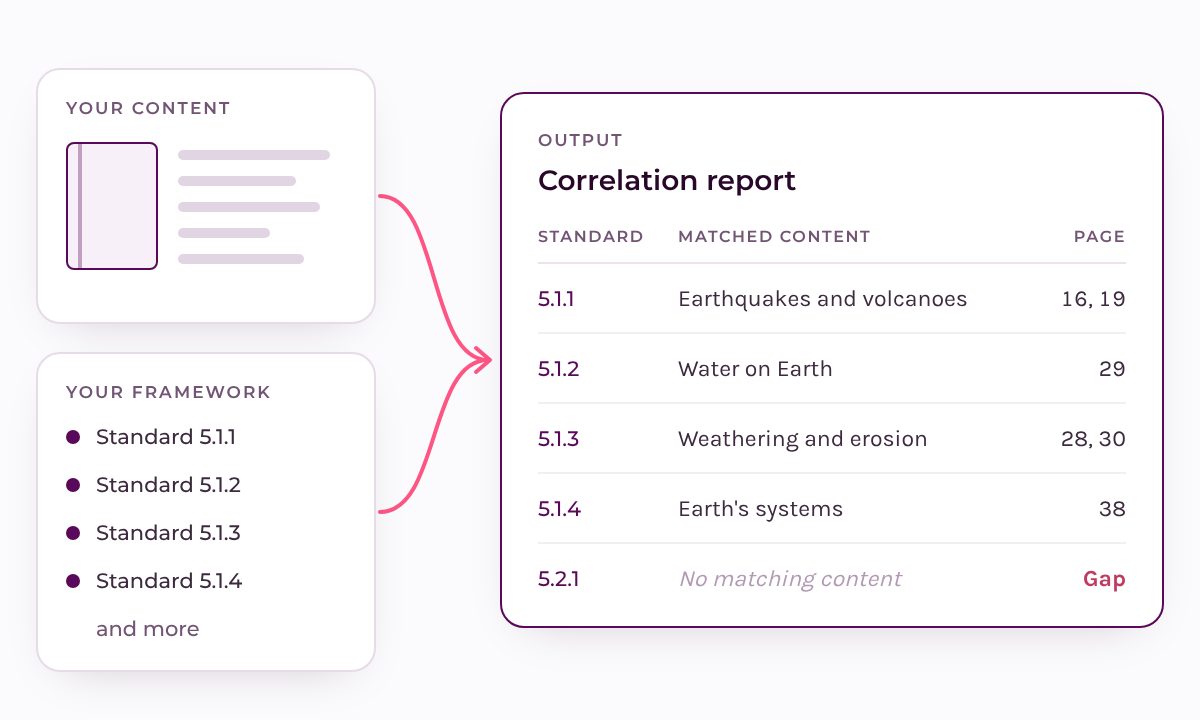
Ludenso helps editorial teams correlate textbooks and learning content, with accurate references and the reasoning behind each proposed match.
US state standards, CEFR, national and regional curricula, or one curriculum against another.
Trusted by



Books, articles and other learning content mapped to US state standards, even when metadata is limited.
Exercises checked against the CEFR descriptors, level by level.
Content mapped to a curriculum or syllabus by grade or stage.
Two curricula compared objective by objective, for a curriculum change or a new market.
Gap analysis can be added to any of these. It shows which standards have little or no coverage in your content.
These are their results. Yours will depend on the framework, the content and the review you want.
Express Publishing · CEFR mapping
From 30 to 40 days to about 2 hours
That is the mapping phase per coursebook, which a senior editor used to do page by page. Express now publishes its CEFR reports proactively, instead of only making them when a customer asks.
It's drudgery to sit down and do this. Your brain gets lost.
Maria Lalea, Editor in Chief for Secondary Education
Read the case study →Human Kinetics · US state standards
70 to 75% less production time
A correlation went from 15 to 16 hours in house to two to four hours including review. The team can now take on projects it used to turn down.
I would prefer never to do them from scratch ever again.
Bethany Bentley, Acquisitions Editor
Read the case study →Correlation projects differ in framework, content, level of detail and final output. We set up the process around what you need.
Your content, your framework, the level of detail and what the report is for.
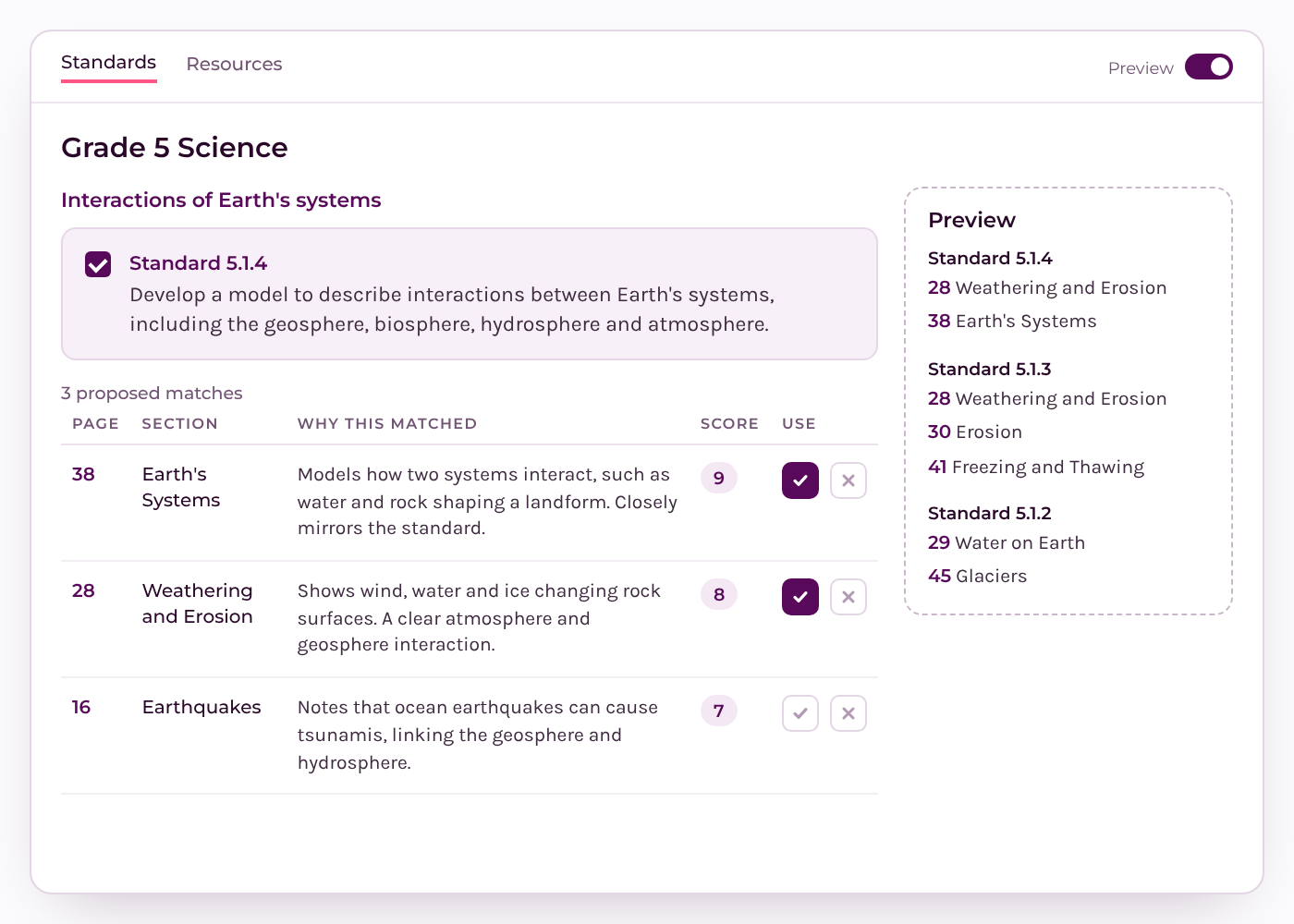
Each one comes with a reference to the source and the reasoning behind it.
They include, skip or adjust each match. The report comes in the format you need.
For each proposed match, your editorial team can review:
The standard or learning objective
The matched content and where it appears
The reasoning behind the proposed match
Your editors decide what to include, skip or adjust before the final report is produced.
Your content remains yours and is never used to train AI models.
You keep full ownership of your intellectual property
Content is stored encrypted, with restricted access and full audit trails
Our model providers work under enterprise agreements that do not retain or train on your data
Gap analysis can be produced alongside any of these, using the same underlying work.
Each proposed match is presented with the standard it was matched against, the content that matched it, a reference to where it appears, and the reasoning behind the proposal. A reviewer can open any match and trace it back to the source. Matches that fall below the threshold your team sets are flagged rather than included.
Yes, and the workflow assumes it. Ludenso proposes correlations, and your editors accept, reject or adjust them and hold final sign-off on what the document claims.
No, correlation projects differ in several ways. The content varies, the framework varies, and the level of granularity a publisher needs varies with it. So does the reason for producing the correlation, whether that is a state adoption, a CEFR mapping, a curriculum update, entry into a new market or a review of coverage in an existing title. We agree the scope and the depth of the analysis with you before the work starts, and shape the output around what the report has to do.
There is a wide range here, and no single turnaround applies. Some publishers handle correlations internally, others use external consultants or specialist providers, and lead times differ accordingly. The volume of content, the framework and the number of review rounds all affect it.
As two examples: the CEFR mapping phase at Express Publishing went from 30 to 40 working days to about two hours, with QA still following it. Human Kinetics reported 70 to 75% less production time on correlations that had previously taken 15 to 16 hours internally.
Publishers retain full ownership of their intellectual property, and textbook content is never used to train AI models. Content is held in encrypted environments with restricted access, and the model providers we work with operate under enterprise agreements where publisher data is not retained or used for training. The AI safety and compliance page covers the detail.
Tell us what you publish and which framework you work with. We will show you what a correlation on your material could look like.
Book a demo
