Meet PAIGE: AI Guided by Educational Purpose
How F.A. Davis built an AI tutor around productive struggle, designed to help students think rather than think for them.
“A lot of different vendors were trying to sell us on their approach to AI,” says Megan Klim, who leads digital product strategy at F.A. Davis.
F.A. Davis was already exploring what AI could do; however, putting it in front of students was a different question. It needed a clear purpose beyond simply being able to say they had AI.
“We might not be the first to market with some of our digital efforts,” Megan says, “because we are being very intentional about how we design them.”
PAIGE, an AI tutor for students, launched in May 2026. It explains concepts, answers questions, and helps students as they complete their coursework. One of its most important design choices, however, is knowing when it should hold back. In some of the moments when students most want an answer, PAIGE is deliberately designed not to give them one.

The Challenge
The hardest work happens alone
“Students are often completing their homework independently on a digital platform outside of the classroom,” Megan says. “They need support during that process, when an instructor may not be available.”
The work waiting for them there is the kind that is hardest to do alone.
“There’s a lot of information students need to know, but knowing it isn’t enough,” Megan says. “The real challenge is being able to apply that knowledge when the situation changes.”
Katie Jones-Aiello, a digital product strategist at F.A. Davis, points to what happens when those students eventually enter clinical practice.
“Nurses need to have this clinical judgment and reasoning to work through all the different healthcare situations they’re going to be faced with.”
At the same time, F.A. Davis was seeing a change in how students approached learning. Students arriving after the pandemic had not always developed the same study habits and strategies as previous cohorts.
“The COVID pandemic disrupted important opportunities for students to develop their study skills,” Megan says. “We need to consider how to support students who are still building those important foundations.”
Generative AI makes that challenge more urgent. When students get stuck, they no longer have to work through the problem or wait until they can ask an instructor. They can get an answer immediately. And for a student who never built the habit of pushing through difficult material, asking for the answer becomes the obvious move.
For F.A. Davis, the question was whether AI could offer students support when an instructor was not there, without doing the thinking for them.
The Publisher
AI had to have a reason to be there
F.A. Davis is a U.S.-based independent publisher focused primarily on nursing education, as well as other health professions such as physical therapy and surgical technology.
Katie came to the role with experience across both editorial and sales. Having seen digital products from both sides, she had strong views on what should drive their development.
“In my experience with other publishers, the emphasis was often on simply selling the platform, with less focus on the quality of the content or how it would help students,” Katie says. “In developing PAIGE, we wanted the focus to be on supporting student learning.”
Both Katie and Megan approach digital products from an editorial perspective, with the learning experience as the starting point.
“I think there can be a tendency to prioritize technology over educational value, since there are so many things you can try and experiment with,” Megan says. “But we want to make sure it fits into the broader learning experience and supports the journey we are creating for instructors and students.”
That was also how they approached AI.
“We don’t want to fall behind where others are, but we also want to be thoughtful about how we incorporate AI. We don’t want to have it just for the sake of having it.”Megan Klim, F.A. Davis
F.A. Davis was already experimenting with AI internally, using it to make everyday operational and verification work more efficient. But putting AI directly in front of students was different.
For Megan, putting AI in front of students raised a fundamental question. Where would the information in its responses come from, and could students trust it?
“Where is it coming from? That was my biggest concern. Whether it would wander or hallucinate.”
F.A. Davis was comfortable exploring where AI could make their own work more efficient. But when it came to the educational content students relied on, the source still needed to be human expertise.
“We want to make sure the primary content always comes from an expert.”
One early proposal from another vendor helped crystallize what F.A. Davis did not want. The idea was to generate quiz questions using information from the open web, while grounding the answers in F.A. Davis books.
For Megan, that was backwards.
“Our books, all of our content, are designed around specific learning objectives and core concepts that nurses need in practice. Why wouldn’t you start there? That trusted content is what should guide both the questions and the answers.”
Grounding the answers was not enough. F.A. Davis also wanted control over what the AI chose to teach in the first place.
The Approach
What would the instructor do?
By the time F.A. Davis and Ludenso started talking, F.A. Davis had already explored several approaches to AI.
What became clear in the conversations was that the teams agreed on something fundamental. The goal was not to take an off-the-shelf AI tool and add it to the platform. They wanted to design around the learning experience F.A. Davis had already created.
“We looked at several approaches to AI, but we feel most comfortable if we’re designing something with a partner, rather than taking something off the shelf and trying to plug it in,” Megan says. “The conversations that we had made us feel like this was the right match for us.”
The question that shaped PAIGE was simple:
What would a good nursing instructor do if a student was stuck?
“If you sat down with your best nursing instructor and said, ‘I really don’t know how to answer this question,’ they would start asking you questions,” Megan says. “What do you know about this? What stands out to you?”
Instead of solving the problem for the student, the instructor might point them towards a piece of information and ask them to think again.
“Pay attention to this data. What might that mean?”
That was the experience F.A. Davis wanted PAIGE to recreate.
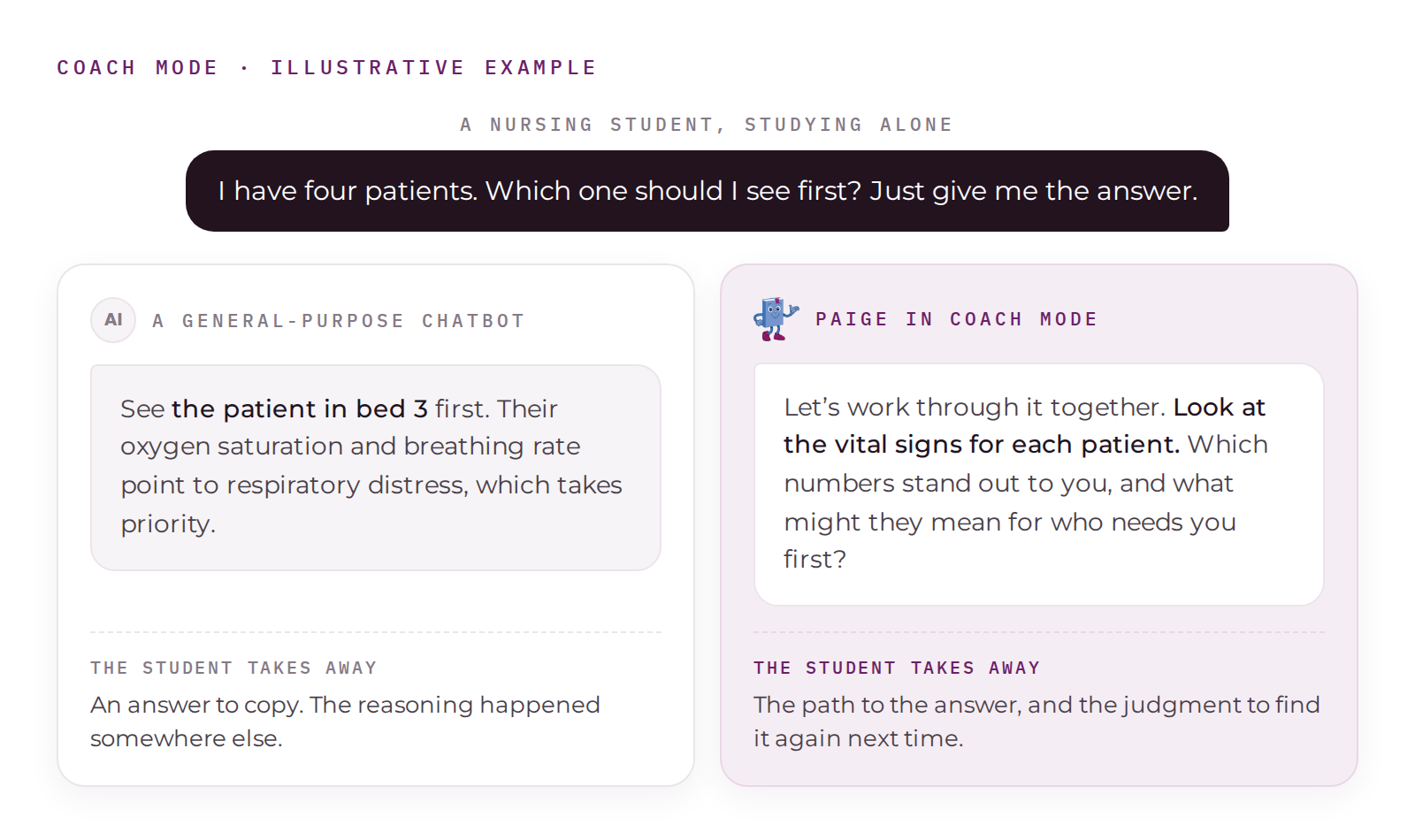
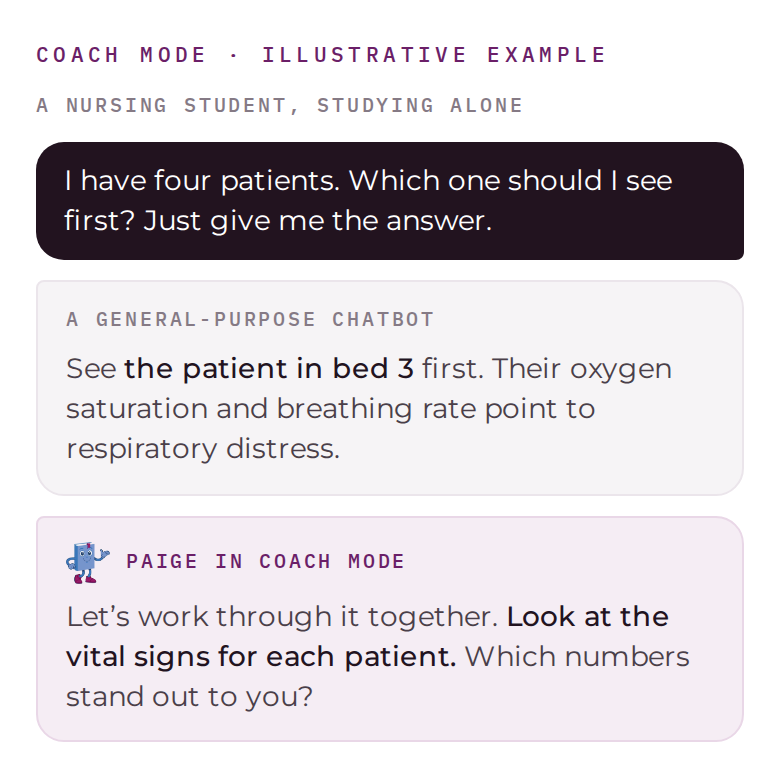
“When you think through something, you learn it,” Megan says. “If someone just gives you the answer straightaway, you don’t see how to reach it on your own. Working through the problem helps students develop their reasoning and retain what they’ve learned.”
F.A. Davis calls this productive struggle.
That focus long predated their work with AI. It was already built into F.A. Davis’s clinical judgment activities, where students work through problems, make connections and develop the reasoning they will eventually need in clinical practice.
“Clinical judgment is hard, and students are used to having an instructor talk them through it,” Megan says. “We wanted to give them that same kind of support when they’re working on their own, without simply giving them the answer.”
That became the role for PAIGE: helping students through the difficult parts without doing the thinking for them.
The Design
One tutor, three different jobs
PAIGE does not behave the same way everywhere within the learning experience.
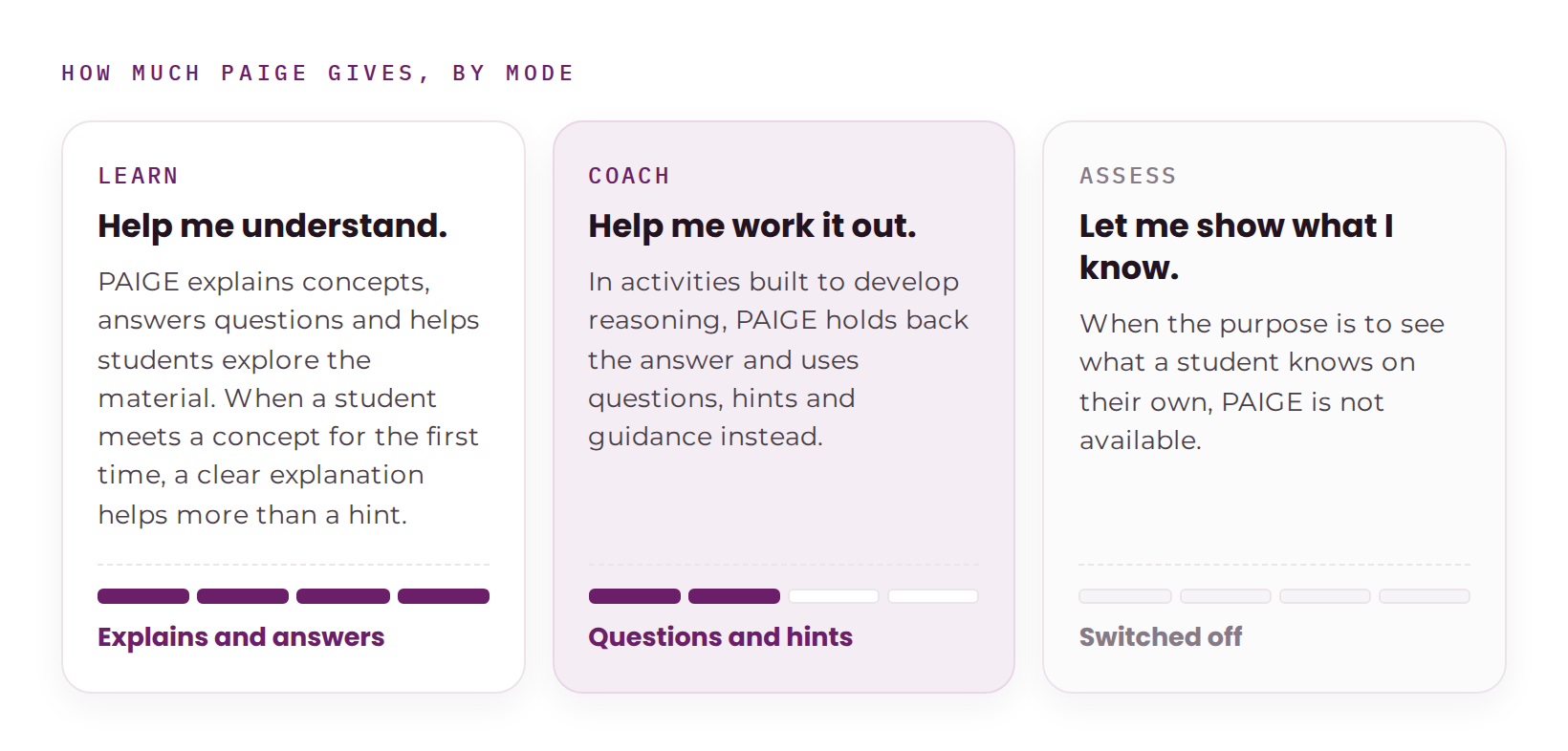
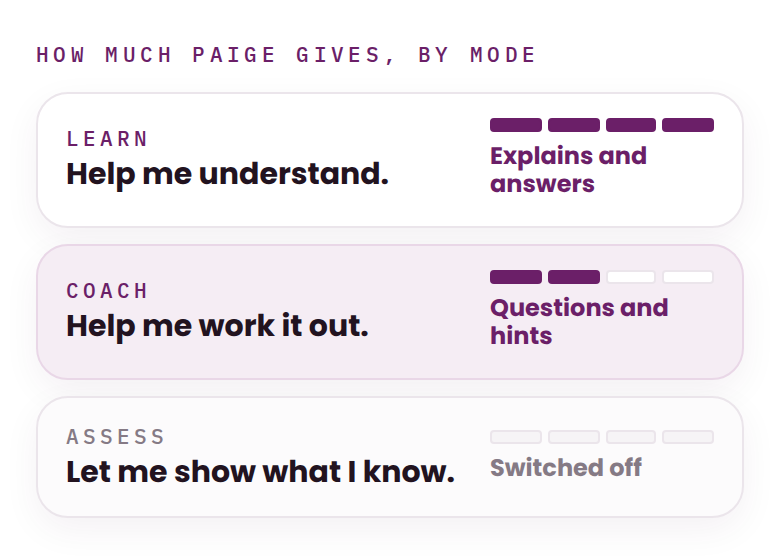
When a student meets a concept for the first time, a clear explanation helps more than a hint. When the activity is about reasoning, PAIGE holds back the answer.
Students do not simply choose whichever mode gives them the most help. PAIGE’s behaviour changes according to where the student is within the platform and what that activity is designed to achieve.
“We decided based on what the outcome of the assignment type was, or where the student was in the platform, what made the most sense,” Megan says. “We wanted the level of support to align with the intended learning outcome.”
During assessments, that means no PAIGE at all. If the purpose of an activity is to establish what a student knows independently, an AI tutor would undermine the point of the assessment.
Katie says the separation between the modes is one of the choices she is proudest of.
“A lot of the other chatbots we’ve looked at, they just kind of put a full slew of questions with the answers sitting alongside them,” she says. “So you’re not actually testing yourself.”
Coach mode may even frustrate students initially.
“It may be uncomfortable at first,” Megan says. “Students may initially expect an immediate answer, but then once they get used to it and understand why those guardrails are in place, their expectations shift. They begin to recognize, ‘Okay, I see how this is helping me learn,’ and they start to learn what questions to ask.”
The Requirements
Six things F.A. Davis would not compromise on
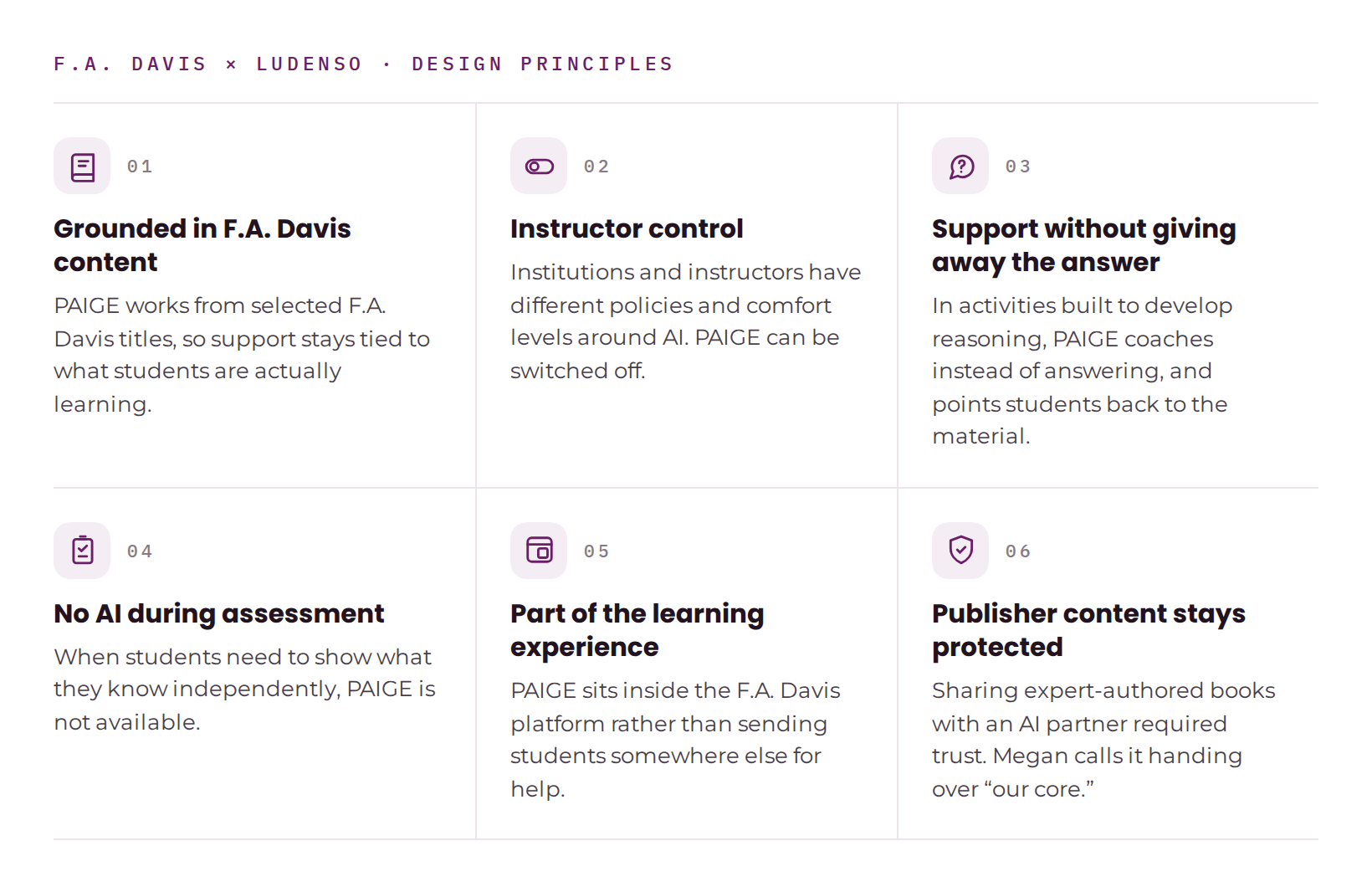
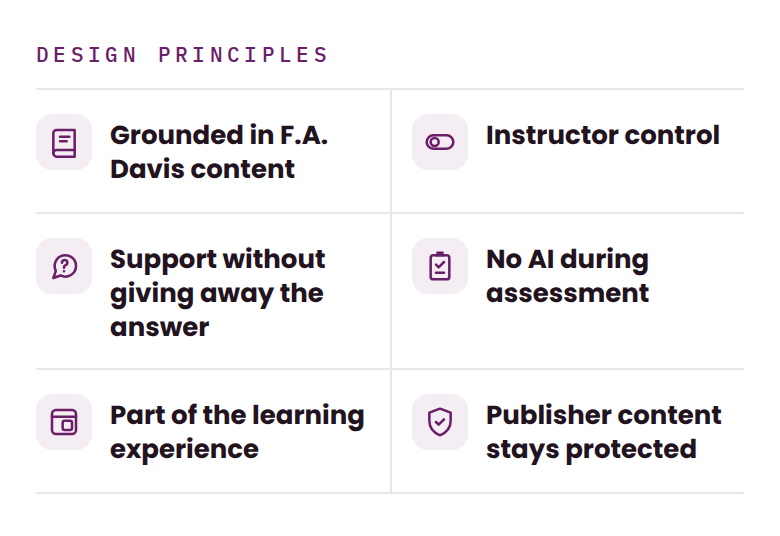
PAIGE works only from selected F.A. Davis titles and sits inside the F.A. Davis platform. It coaches instead of answering, stays off during assessment, and instructors can switch it off. For a publisher, sharing books with an AI partner required trust. Megan calls it handing over “our core.”
The Partnership
Built together, not bolted on
The version of PAIGE students use today was not designed in a single product meeting.
A key moment came when the Ludenso and F.A. Davis teams spent a week together in Philadelphia, working through how PAIGE should behave inside the actual learning experience.
Where should Coach appear? When should PAIGE answer directly? When should it hold back? How should it respond?
The teams could test an idea, change it and come back to it together the next day.
“We were sitting up till midnight before the next meeting to try to get it to work the way that you said it would work,” says Eirik Wahlstrøm, Ludenso’s CEO.

That way of working suited F.A. Davis. Being a smaller publisher means there is less room to make expensive bets that do not work, Megan says. But it also means the people who understand the content, product and market can work closely together and make decisions quickly.
“We make sure to bring together people with the expertise needed to make informed decisions, so we can build the best experiences for students and instructors,” she says.
For this project, that meant bringing together two different kinds of expertise.
F.A. Davis knew its students, instructors, content and pedagogy. Ludenso knew how to build the AI around those requirements.
“We’re not experts in AI. We are experts in our markets. I think magic happens when you have the right people in the room and there’s a little bit of friction between the needs.”Megan Klim, F.A. Davis
That friction changed the product.
“What we started showing you was vastly different from what we ended up launching,” Eirik says.
“Yes,” Megan says. “And I’m really happy with what we ended up launching.”
The Results So Far
What they know so far
PAIGE is now being used by instructors and students, with F.A. Davis supporting them in understanding where AI appears, how it behaves and when it is switched off.
That control for the instructors has been important.
“We’ve made them feel like they have control. They know it’s off during assessments,” Katie says. “I think we’ve provided them a lot of support to make them feel comfortable with something that can be kind of scary to them.”
But for Megan, instructors have a role beyond deciding whether PAIGE is available. They also help shape how students learn to use AI in the first place.
“Instructors set the tone for how students use AI,” Megan says. “They can help students learn to use it as a learning tool, rather than simply somewhere to go for an answer.”
Without that guidance, students can easily fall back on the habits they have developed with general-purpose AI, where the easiest option is often simply to ask for an answer.
That was one of the concerns F.A. Davis had from the beginning, AI can make it very easy for students to offload parts of the learning process. With PAIGE, they wanted students to stay actively involved, asking questions, working through problems and making connections themselves.
There was another early concern too. Could an AI tutor reliably stay within F.A. Davis’s trusted content? On that, Megan says her confidence has grown.
“Seeing how closely PAIGE’s responses reflect the content in our books has strengthened my confidence in the support it provides students. It stays firmly rooted in our content, keeping its responses relevant to the material students are studying and applying.”Megan Klim, F.A. Davis
PAIGE also shows students where in the book its answers come from, so they can check the source themselves.
What’s Next
From one book to the student’s wider education
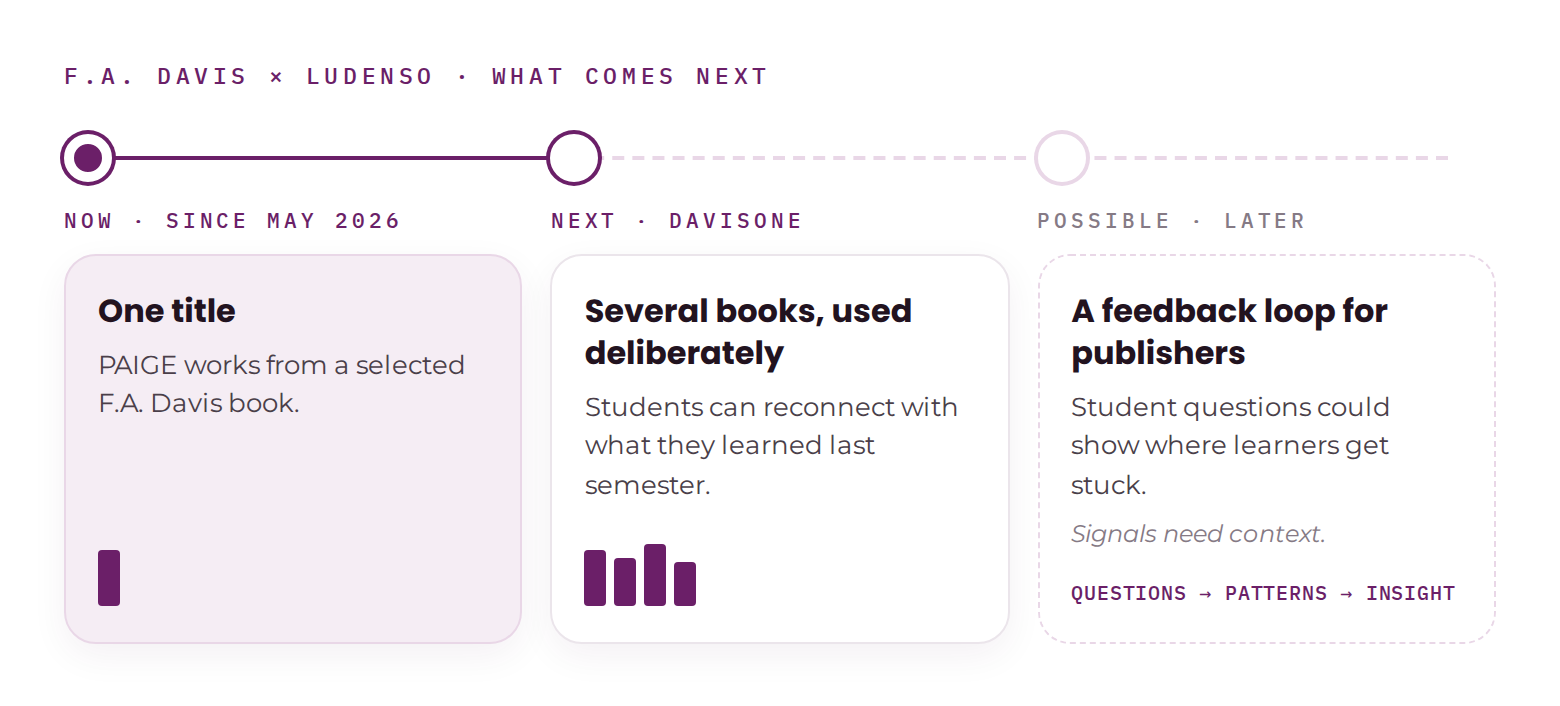
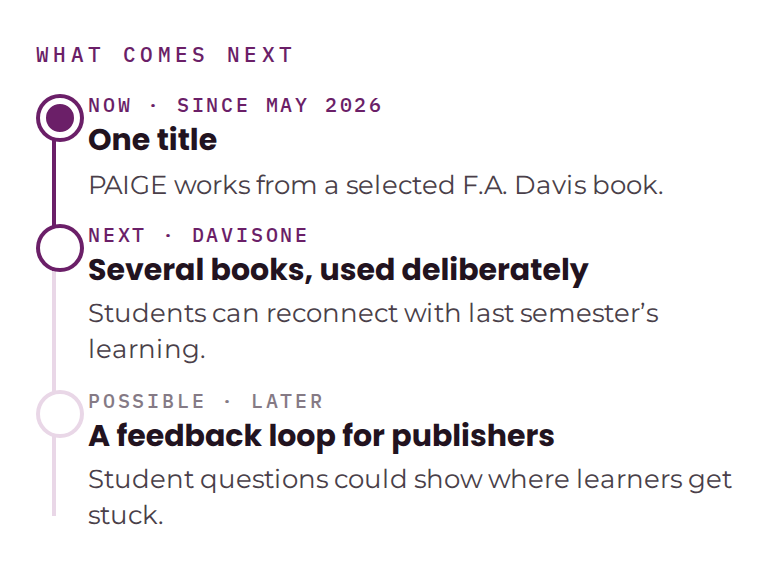
The next step is to bring PAIGE into DavisONE, where it will be able to work across several F.A. Davis books rather than being limited to a single title.
But F.A. Davis does not want “more sources” simply for the sake of having more information available.
The same principle that shaped the first version still applies. PAIGE needs to understand which content is relevant in which context, and its access to multiple sources needs to be designed deliberately.
“The fact that we’re talking about weighting it and being intentional about how it’s used with multiple sources is carrying on the same mission that we had in the first round,” Megan says.
For nursing students, there is a practical benefit. What they learn in one semester does not stop being relevant when they start the next course.
A student might need to ask, “I learned this last semester. Can you remind me?”
Instead of searching the wider internet, PAIGE could help them reconnect with material they have already been taught across their F.A. Davis resources.
As Megan puts it, the goal is “keeping continuity in their education.”
The Bigger Picture
A new feedback loop for publishers
There is another possibility that comes with students asking questions directly alongside their learning material.
Until now, publishers could see what they published and instructors could see what happened in their classrooms. But it has been much harder to see the individual moments when students get stuck while studying on their own.
The questions students ask an AI tutor could eventually offer another signal.
“If we can see patterns of the questions that people are asking, or where they’re getting stuck, that’ll help us not only enhance the book but enhance the support around it,” Megan says. “It also tells us what’s important to people. What are the topics that people are teaching?”
Megan is equally clear that those signals would need context. A spike in questions around one topic does not automatically mean there is a problem with the content. It could simply mean that a large institution assigned that topic that week.
For now, it points towards a broader possibility–AI could eventually do more than support the student reading a textbook. Used carefully, the questions students ask could also help publishers understand how their content is being experienced.
That brings the story back to why F.A. Davis approached AI the way it did in the first place.
“We wanted to make sure this felt like an intentional choice rather than an experiment. We wanted to have AI, but how do we use it in a way that is meaningful?”Megan Klim, F.A. Davis
For PAIGE, one answer was simple, sometimes the most useful thing an AI tutor can do is not give the answer.

