
Over the past three years, one question has come up again and again in conversations with educational publishers, researchers and technology leaders:
What becomes of publishers in the age of AI?
As founder and CEO of Ludenso, Eirik Wahlstrøm has spent the last six years working alongside publishers across Europe and the US, speaking with hundreds of publishing executives, collaborating with industry partners, and helping publishers bring AI into educational products. Along the way, the questions changed. People stopped asking what Ludenso was building, and started asking what he was seeing across the whole industry.
This article is Eirik's attempt to connect those dots. It brings together insights from those conversations, research from across the field, and Ludenso's experience building AI with educational publishers.
One conclusion stands out:
“AI didn’t make publishers obsolete. It’s making everything but trust obsolete, and that’s why publishers have never been more important.”
As generating content becomes trivial, the scarce resource is no longer information, but knowing what to trust. Publishers have spent decades earning exactly that. Every content piece is reviewed by subject experts, aligned to curriculum, and accountable to the classrooms that use it. Those strengths don't become less valuable in the age of AI. They become the foundation that trustworthy educational AI depends on, Eirik argues.
.png)
It is tempting to read generative AI as an extinction event for publishers. If a model can draft a plausible biology chapter in seconds, what is left to sell?
Wahlstrøm sees it the other way around.
When AI can produce anything, the question is no longer about access to content. It's about trust, and who stands behind it. Publishers fill that widening gap.
He points to the way information is consumed today. For a decade, the world has been flooded with clickbait, fake news, and algorithms that feed people more of what they already believe. Generative AI accelerates that trend and adds another challenge, he says. It produces enormous amounts of content that looks convincing, even when parts of it are inaccurate or entirely fabricated. As the volume of information grows, it becomes harder to know what to trust.
Hallucinations remain one of AI's most persistent, unsolved problems, which is exactly why the question of what you can trust matters more, not less.
That is where publishers come in. Their value has never been simply producing content, but ensuring that the content has been reviewed, edited, fact-checked, and shaped by people with expertise in the subject. What a publisher contributes is the confidence that the material reflects the local curriculum, is appropriate for the intended age group, and has been developed alongside educators who understand the local classroom.
This is why Ludenso has chosen to work exclusively with publishers. Building trustworthy educational AI is not a feature you add afterwards. It demands deliberate focus on trust, safety and pedagogy from the ground up, and that work can only be done in partnership with the people who own the trusted content.
There is a lot of discussion around “safe AI,” but Wahlstrøm believes the term only matters if it can be translated into something measurable.
Today's models sound equally confident whether or not they are right. The industry's standard answer is “retrieval.” Ground the model in the textbook and show the citation. But research from Google suggests that grounding alone can make the problem worse. Adding context makes a model more confident, and more confident models stop saying “I don't know.”
Counterintuitively, Google's research found that Gemma hallucinated far more often when given insufficient context than when given no context at all. Incorrect answers rose from 10.2% to 66.1%. (Read the study.)
For a publisher, this is an uncomfortable finding. A retrieval system pointed at your textbook can be more confidently wrong than one pointed at nothing, and it will hand the student a citation to your book while it happens.
A citation is not the same as validation. An AI can point to the right page and still get the answer wrong.
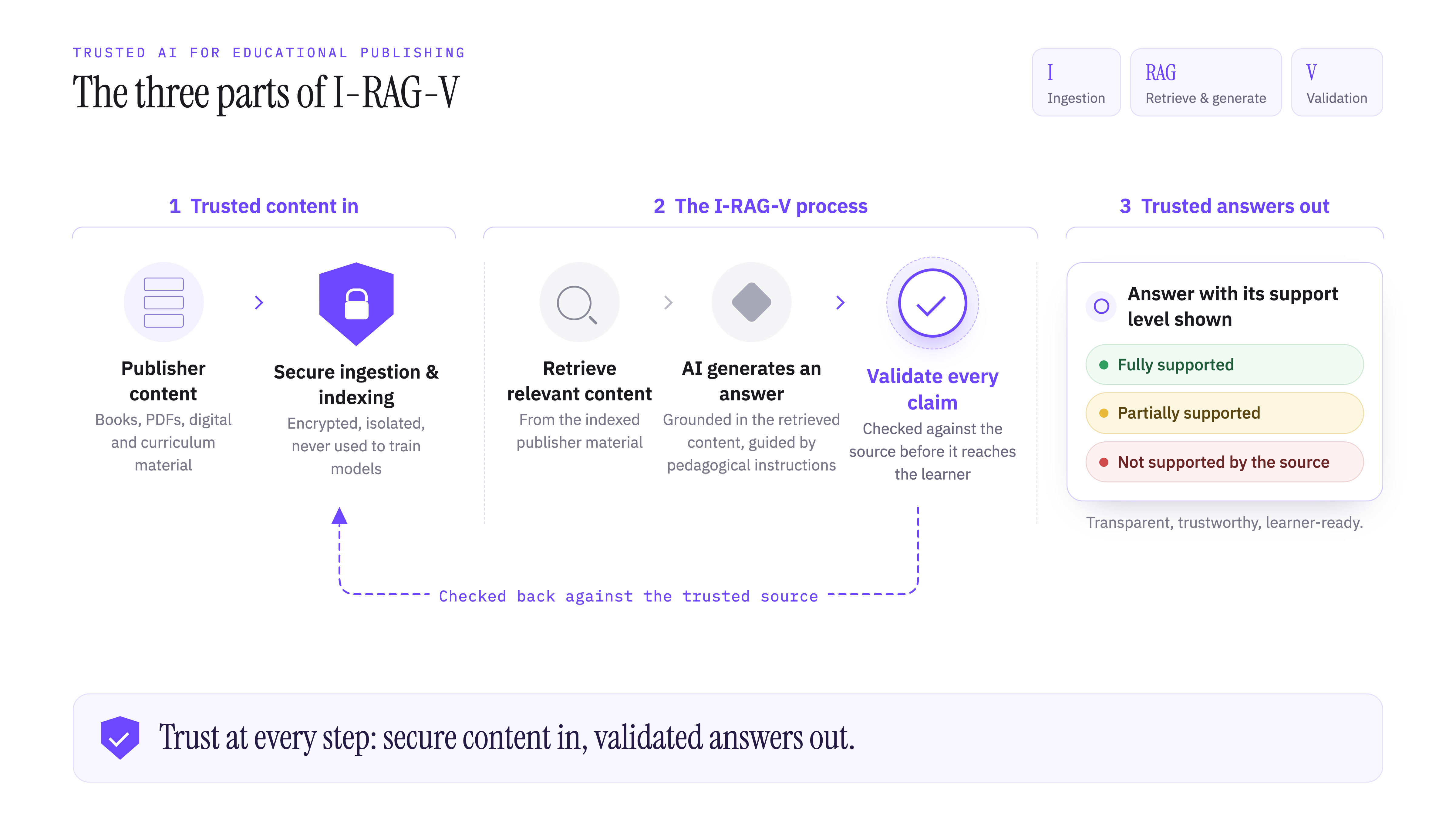
This is why Ludenso's architecture is I-RAG-V, where the “V” stands for validation. After an answer is generated, it is checked back against the source material to establish whether the claim is actually supported.
The result is shown directly to the learner:
The goal isn't to pretend the AI is always right, but to be transparent about what can and cannot be trusted. And to let the system admit when it doesn't know.
Those design choices came directly from conversations with educational publishers. Across more than one hundred conversations with publishing leaders, the same three priorities came up again and again: trust, safety, and pedagogy. Those priorities guided not only what we built, but how we built the I-RAG-V engine, Eirik says.
Those three answers became the specification for everything Ludenso has built since. Trust and safety, we can build for. Pedagogy, the hardest of the three, is where it gets complicated. It is also where Ludenso spends most of its research and development efforts, because getting it right is what turns generic AI into educational infrastructure you can trust.
Trustworthy answers are important. But for Wahlstrøm, the bigger question is whether AI helps students learn.
This challenges the metric the education industry trusts most: engagement. Wahlstrøm points to research from a Cambridge team that compared students who used AI with students who took notes. Most of the note-takers performed better on memory and comprehension, while most of the AI users did not.
Most of the students who used AI believed they had learned more and enjoyed it more. While in fact, they remembered and understood less. That is a dangerous cocktail.
.png)
In other words, Eirik says, you believe you are learning more while you are actually learning less, so you keep choosing the method that teaches you least. The shortfall is invisible to the learner, who feels more engaged and more confident that they have understood.
That creates a difficult design challenge. How do you keep the learner engaged and thinking without simply handing over the answer? Today's general-purpose models are built to do the opposite. They are productivity tools, designed to reach an answer as quickly as possible, which is often the wrong instinct for learning.
"A general model can give you a correct answer to the wrong question."
If an answer is not grounded in the learner's level, curriculum, and context, it can still be the wrong answer, even when it is technically correct.
The AI tech companies are spending enormous effort measuring accuracy, precision, latency, and retrieval performance. Yet one question is often overlooked: “Does the tool help students learn?”.
A recent review of 47 educational RAG chatbots found that not a single one evaluated its impact on learning outcomes, despite education being the very reason these systems exist. (See the study.)
Too much of the conversation is about whether the AI can answer questions. The more important question is whether students learn more because of it.
That gap is where Wahlstrøm believes the industry should focus next. Building trustworthy AI is important. Understanding whether it improves learning is essential.
Almost every publisher we speak to has already passed the question of whether to use AI. It is in their workflows, in their products, and in the hands of their learners. The harder question is the one underneath it. “How do you move at the speed the market is now demanding without giving up the quality, trust, and educational value that make your name worth something in the first place?” - Eirik.
That tension is why so many publishers have spent two years thinking carefully and shipping little. But deliberation has a price, because the technology keeps compounding. A year spent on the sidelines is not a year held even, but a widening gap: in workflows competitors have automated, in bids answered faster, and in products the buyers have started to treat as standard.

Case in point: last December, Human Kinetics turned around a full set of standards correlations, a project that would have been out of reach a year earlier, in one working day over the Christmas break with the help of Ludenso. Read the full case study here.
The Future of Textbooks Summit, Ludenso's gathering that brings together publishing partners and industry thought leaders, did not focus on whether AI would change publishing. That has already happened. What kept coming back was what publishers should do about it, and this article has been our attempt at an honest answer.
Of the three things publishers told us they needed, two are engineering problems and one is not. Trust and safety we can design for and demonstrate. How these tools can help students learn more is still genuinely open, and it will be answered by researchers and educators in collaboration with technology companies and publishers.
This series is built on other people's thinking, not just ours, so it only works if we keep talking to the right people. Who should we sit down with next? What's the question about AI and publishing you wish someone would just answer honestly? Email Line Assev at line@ludenso.com and tell us. We read every message, and it shapes who we bring in next.
Subscribe to Letters from Ludenso to get the next article directly in your inbox.
Everything above is the conclusion. What follows is the story behind it. How Ludenso went from augmented reality to AI, what publishers told us along the way, and how those conversations shaped the products we build today.
Publishing is often a local business where curricula, ministries, adoption cycles, regulations and reading habits all stop at borders. This means most publishers know their own market thoroughly and everyone else's by reputation. Over the past six years we have worked with K12 and higher education publishers in Europe and the US, and what has struck our founder and CEO, Eirik Wahlstrøm, more than anything is how often the same questions turn up in Oslo, Athens, Cambridge, and Philadelphia, in different languages and almost the same words.
At our Future of Textbooks Summit in May, one question surfaced repeatedly: “What does the role of publishers look like in the age of AI?”. The feedback after the summit was consistent. Guests valued hearing how other executives across the industry were thinking it through, and a number of them said they would have liked more of Ludenso's own view than we gave in the room.
This article is that fuller answer, and something of a look behind the scenes. How listening to publishers across the world shapes what we are building, what we have learned about trust, safety, and pedagogy, and what that leaves for the role of publishers.
It starts with the point Eirik makes that surprises people most:
AI will not reduce the importance of publishers. It will increase it.
Ludenso did not start as an AI company. Eirik Wahlstrøm founded it in 2020 with Harald Manheim and Ingrid Fallrø Skrede, building an augmented reality tool that brought textbooks to life, growing from one Norwegian publishing partner to more than twenty internationally within a year and picking up a BETT Award along the way.
Then ChatGPT launched, on 30 November 2022.
Like much of the publishing industry, Ludenso could have stayed the course. The AR business was growing, the research behind it was strong, and publishers were understandably cautious, weighing contracts, IP, and whether generative AI was a lasting shift or another cycle of hype.
Ludenso chose a third path. Adopt fast, but start internally. Generative AI quickly became the team's own superpower, quietly powering workflows behind the scenes. Metadata tagging for 3D models, alt text generation, and editorial prep that once took days of manual work now took hours. The team built real fluency with the technology before ever putting it in front of a student or a publisher. And it made one thing obvious. This wasn't hype.
Rather than start building, Eirik and the team went out to listen. In the autumn of 2024, they sat down with more than fifty publishing executives across Europe and the US, not only our existing partners, opening every conversation with the same question: “What is the burning challenge you are trying to solve right now?”
Notably, the question said nothing about AI. But the answers kept landing in the same place. How to navigate the AI transition. And when the conversations went deeper, what publishers actually needed came down to three things. Trust, safety, and pedagogy, the same three you read about above.
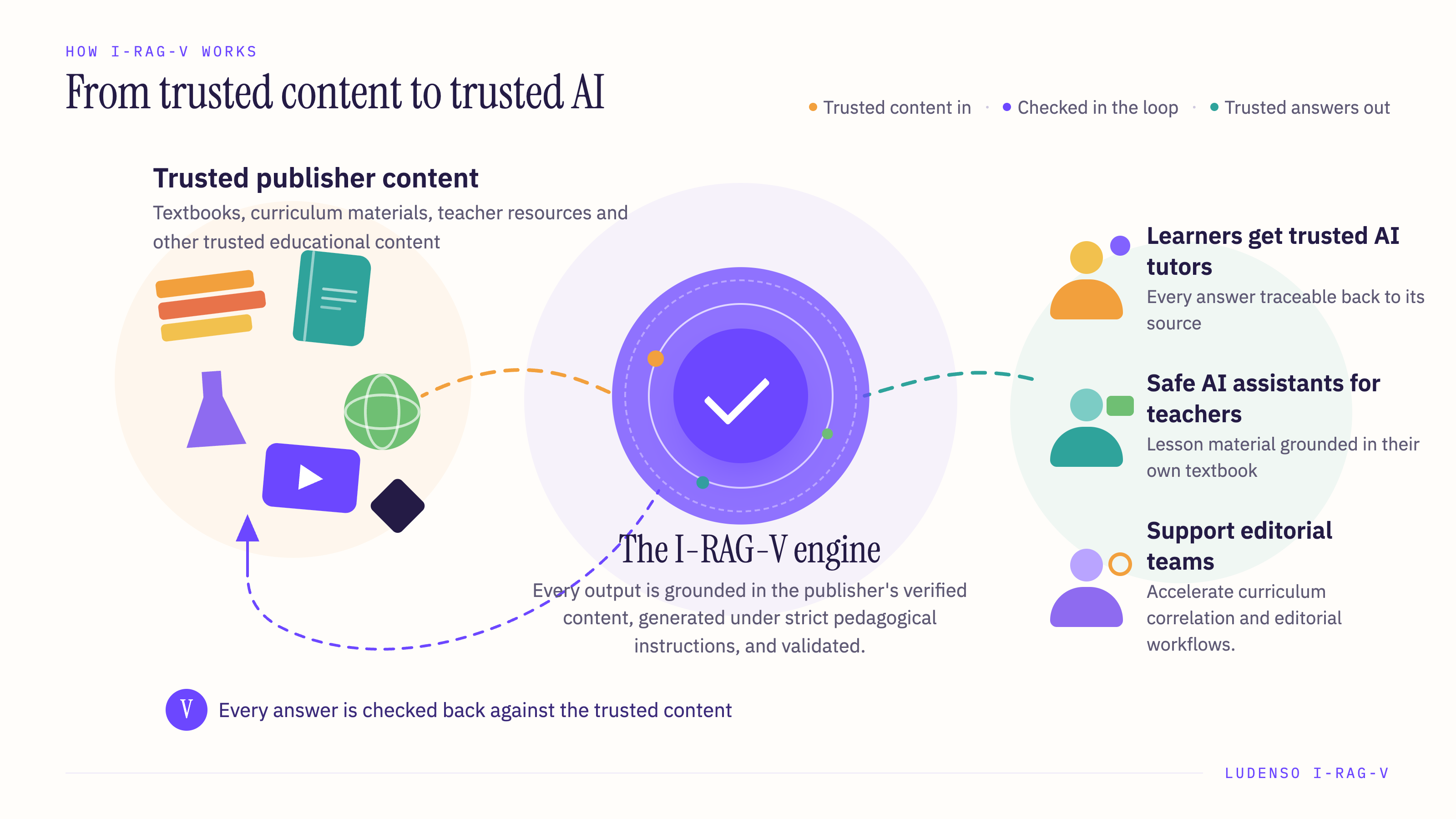
Those three answers became the brief, and they pointed to a different kind of product. Not another chatbot layered on top of a PDF, but AI enablement. Taking everything a publisher already owns and structuring it into an AI-ready knowledge graph, where the content, its curriculum, and its pedagogical intent are machine-readable. Once that foundation exists, the same trusted material can power whatever the use case demands.
Today, that foundation powers three AI applications for our publishing clients. A tutor grounded in the publisher's own textbooks, a teacher assistant that builds resources from the same material, and editorial tools that take repetitive work off people's desks. All of it under the publisher's own name. And all of it shaped by the three answers, not just in what it does but in how it works. Trust is built into the pipeline. Every answer is generated from the publisher's content, then checked back against the source, with the result shown openly rather than taken on faith. Safety is architectural. Publisher content stays separate and encrypted, is never used to train models, and providers are not allowed to retain it.
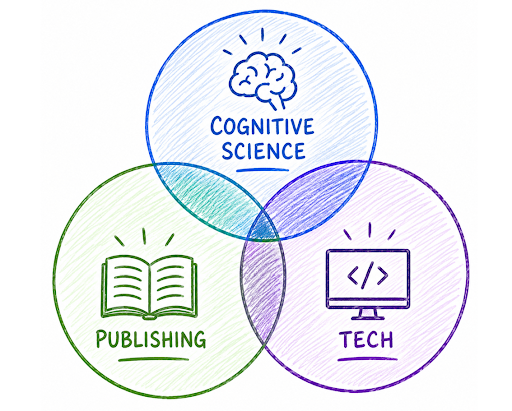
Pedagogy is where we spend the most time, because it is the hardest to get right. We design on cognitive science rather than engagement metrics, working with researchers, teachers, textbook authors, and specialists in didactics, including an ongoing project with Cambridge University Press & Assessment pairing their textbooks with our AI. Whether tools like ours genuinely improve learning is still an open question for the whole field.
What is not an open question is where trustworthy educational AI has to start: with the publishers who have spent decades earning the classroom's trust. Ludenso's mission is to make that trust count in the age of AI, so that the people who built education's foundations are the ones who shape what comes next. If you are a publisher thinking about that future, we would love to talk. Reach us at line@ludenso.com.
.png)
Line Assev joined Ludenso in May 2026 after several years at Kahoot!, where she worked closely with more than a thousand teachers. Her experience through the pandemic shaped her interest in how AI can support education while preserving trust, pedagogy, and teacher expertise.

