An interview series from Ludenso
In this series, Ludenso speaks with partners and thought leaders shaping the future of educational publishing. After the conversation with Tim Oates from Cambridge, this edition takes us to Copenhagen, and a perspective from one of Denmark's most experienced publishing leaders: Henriette Thiesen, Publishing Director at Gyldendal.
Half the time, Henriette Thiesen thinks academic publishers have never been more important. The other half, she wonders if they will exist at all in a few years. In this conversation, she makes the case for what publishers would need to do to end up on the right side of that question.
Henriette has been working in publishing for 25 years. At eleven years old, she was already working alongside her mother in a Danish publishing house, where she was running copies and helping where she could.
She went on to study psychology at university, and her first role after graduating was as a psychology editor at a publishing house. She has never left the industry since. For the past fifteen years, she has worked as a leader at Denmark's largest publishing house, Gyldendal, where she is now publishing director in higher education.
.jpg)
Her psychology background never went away, and it shapes how she thinks about learning and attention, and now about the cognitive consequences of a world saturated with screens and generative AI. That thinking has, she says, become increasingly central to her work, and in ways she did not anticipate.
Generative AI has done something unexpected: it has made publishers think hard about why they exist. It has been implicit that publishers curate and validate knowledge. Now the purpose behind the work needs to be said out loud. The question of what a publisher is for has become urgent in a way it simply was not a few years ago.
Publishing, Henriette argues, is fundamentally about human formation. Gyldendal's values, as she describes them, centre on empowering people and offering different perspectives, backed by validated knowledge, rigour and care. That applies whether the content is a novel, a children's book, or a textbook.
"Humans should be involved in educating people and giving new perspectives. We, as publishers, stand for validated knowledge, thoroughness, and doing things properly", Henriette says.
This, she believes, defines publishing's role in a functioning democracy. Books and the institutions that produce them are part of how a society transmits knowledge across generations.
But defending that role requires understanding what is happening to the people publishers are working to serve.
Before talking about what AI does to learning, Henriette points to what tech disruptions came before it. For the past few years, she says, screens, gaming and social media have eroded the ability to concentrate and read a text start to finish.
Generative AI adds a motivation problem on top of that. She describes the experience of a student sitting down to write a poetry analysis, knowing that a single prompt in ChatGPT would produce something in seconds that would be better than anything they could write themselves.
She has felt a version of it herself: despite having spent her working life writing and editing, she has occasionally found that Copilot produces something she could not have done as well.
"What does that do to us? It erodes your own voice and your own thinking. Even when you prompt it with your own ideas, the result gets shaped, and without quite feeling it, you end up with worse self-confidence, because the result is better than what you would have made yourself", says Henriette
The capacity to feel competent, she argues, is fundamental to being human, not just a by-product of education.
"Feeling competent, feeling that we master something, that is fundamentally important. And I do not think AI is going to have a positive effect on that".
If the problem is that students are losing both the endurance and the motivation to learn deeply, the question becomes what a publisher can offer to help. For Henriette, the answer starts with rethinking what a textbook is for.
One of the sharpest ideas in Henriette's framing of the publisher's role is a reappraisal of what a textbook actually is. She believes that publishers cannot compete with ChatGPT on breadth, and that they should not try. A well-made textbook defines the field. No general-purpose AI chatbot currently does that.
A textbook tells a student: "This is what you need to know". Setting those boundaries is itself a form of expert knowledge, and it is something only people with genuine subject mastery can provide.
"If you have a well-grounded textbook: one that is well-communicated and clearly bounded, the book can say: this is what you need to learn. If you read this from cover to cover, you will actually have a sense of what it means to be a pedagogue. That can give pride in your profession as a pedagogue and a feeling that this is my expertise".
ChatGPT can answer any question, but it cannot tell a student which questions matter for their specific education, or why. Publishers who work with authors, editors and subject experts are in a position to answer that.
The publisher's value lies in the judgment about what belongs in the content, and in the trust readers place in its quality, and not in the text itself. And recently, Henriette says, a rethink of how that content is presented to readers.
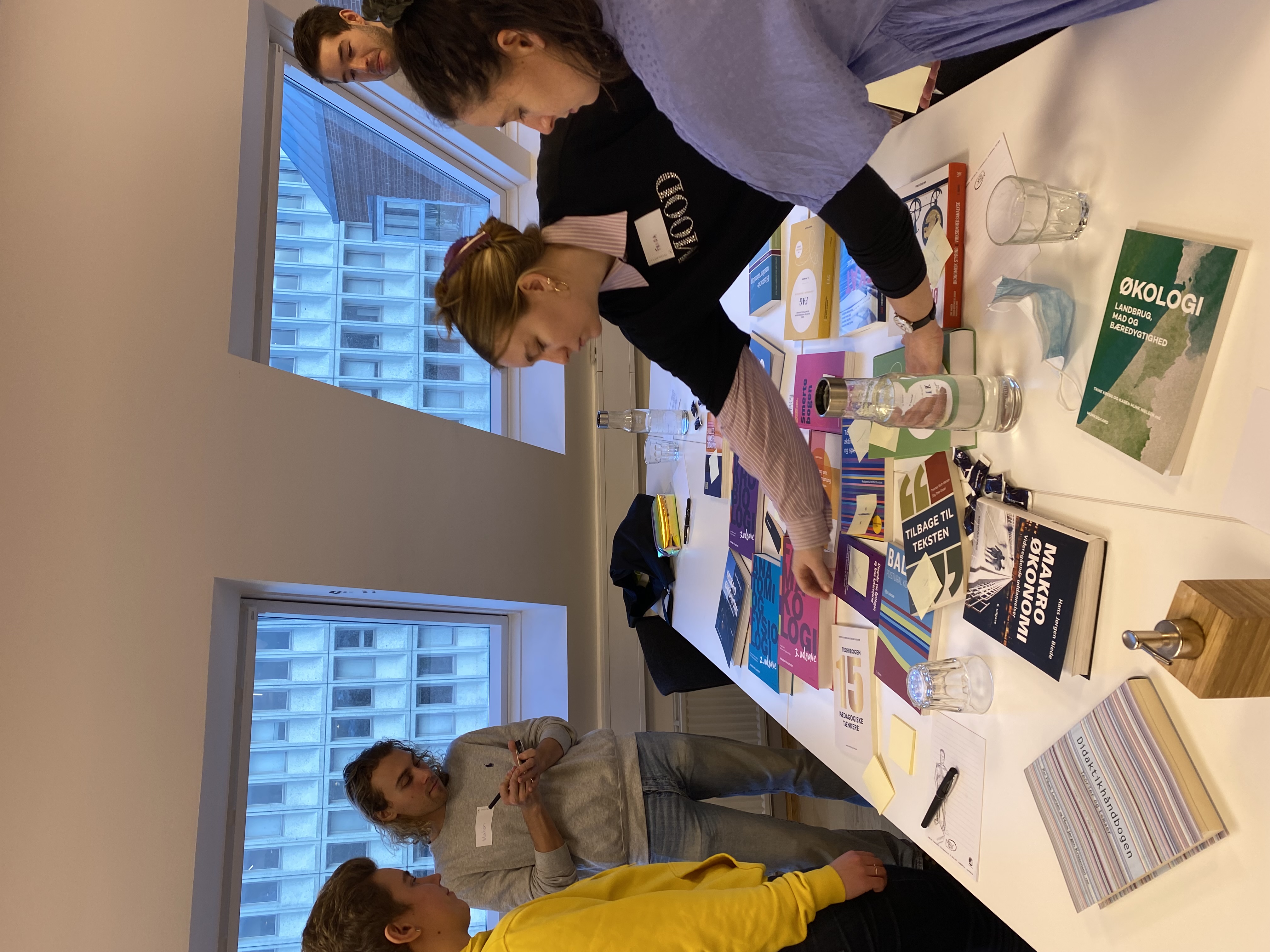
Over recent years, Gyldendal has started talking more to the learners:
"Previously, we had little dialogue with students. If we made a book with a very smart professor, and they thought it was a good set text, it was just a good set text, and we published the book as it was".
Henriette shares that this approach has changed substantially. Gyldendal now runs student advisory boards and involves students directly in product development. This approach has so far resulted in several practical results:
Studybox: an all you can eat streaming platform with textbooks, with several features such as highlighting, mapping, searching and AI functionalities soon to come
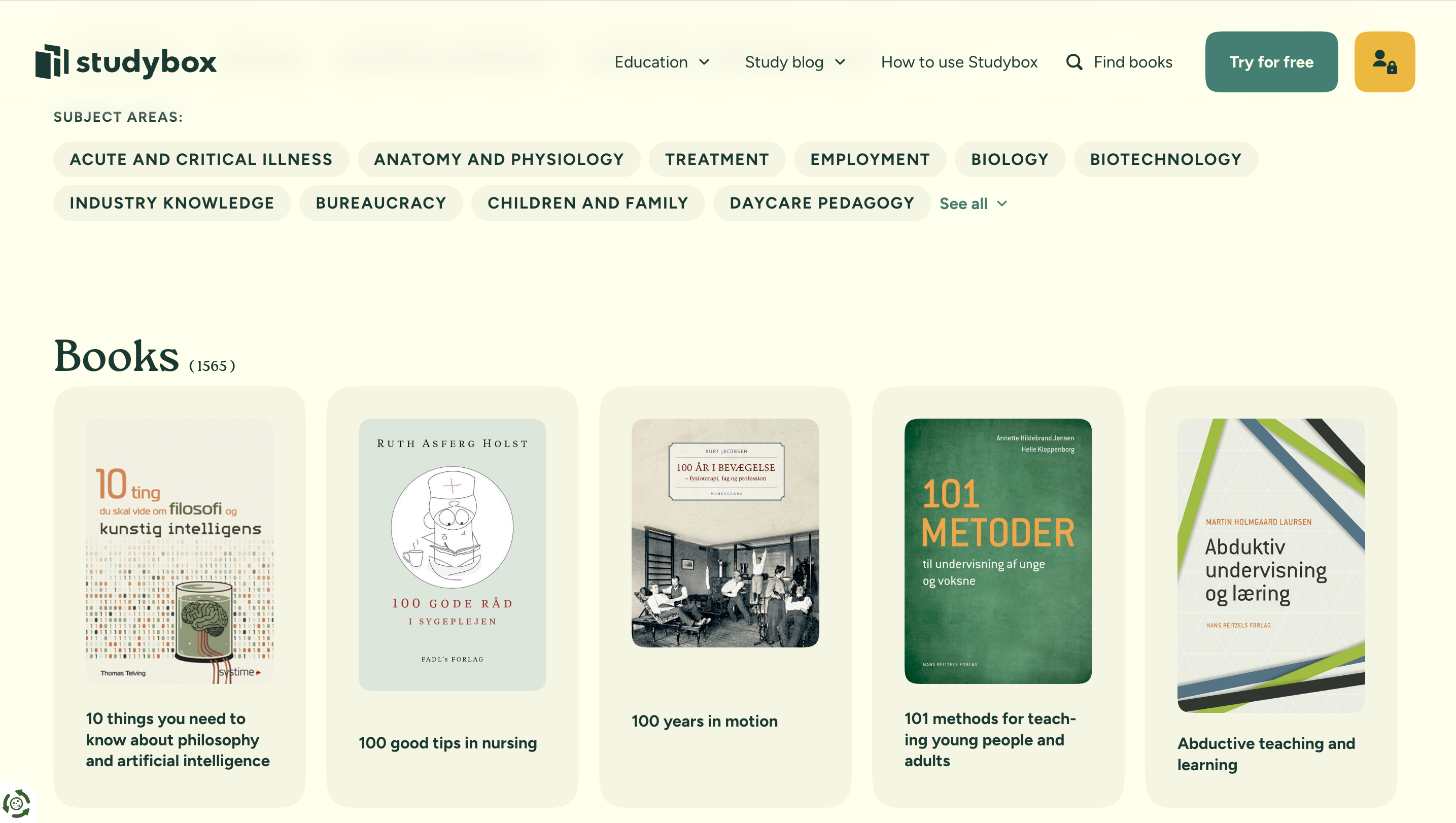
Highlight: a streaming service delivering curriculum content on video, for students who want an alternative to reading a full book.
Redesigned textbooks: built around onboarding, instead of long forewords that no one reads. It also includes visual maps and flexible reading paths.
.jpg)
Ludenso AI pilot: Gyldendal's validated textbooks paired with Ludenso's AI engine, giving students AI functionalities coupled with trusted, publisher-approved content.
Henriette sees this AI project as a way of maximising the potential of their content and making it more accessible to students in a safe and trusted environment.
"Many young people are quite sceptical of AI, even though they all use it. They recognise that they can't always trust it, and that it might not always be good for their learning".
She sees this scepticism as an invitation to publishers, with decades of earned trust behind them, to help support students. The gap between academic writing culture and what students can read and absorb remains one of the most persistent tensions in educational publishing. Using AI to close this gap could be a promising approach to support the new generation of learners.
However, the success of these initiatives depends on something publishers cannot control on their own: who pays for it.
Henriette believes society can no longer avoid one uncomfortable question: do we agree that we need quality-assured, local-language educational content? And if so, who pays for it?
%20(1).jpg)
The current model is not working. Students are increasingly turning to free alternatives instead, such as pirated content, scattered articles, and lecture slides. Publishers cannot keep absorbing the cost of producing major textbooks for a market that is buying fewer and fewer of them. This is not a decision individual students should have to make on their own.
"We have arrived at a point where we cannot leave this to the students, and expect them to think: if I don't buy this book, there will be no books for nurses in five years. We cannot put that responsibility on students".
Denmark is a concrete example of what is at stake. Right now, 20% of nursing students drop out in their first year. If dropout rates like that continue, Henriette says, Denmark will be seriously short-staffed on nurses within fifteen years.
Henriette poses the question directly: "If every nursing student arrived on their first day with a complete, well-designed set of learning materials, and not a pile of photocopied articles and disconnected links, might more of them stay?"
It is, she suggests, one of the cheapest possible interventions relative to its potential impact. Libraries, universities and government could all play a role. The mechanism is less important than the recognition that the decision needs to be made. Unfortunately, the political will is largely absent.
"In Denmark, we just had an election campaign where AI barely featured at all. I think it's because it doesn't appeal to voters. The topic is so complex that you quickly become the person standing on a soapbox predicting doom, and then everyone says "well, we got pocket calculators and that was fine." But this is not the same".
Henriette believes the decisions that need to be made are still makeable, if we act now.
At the start of this conversation, Henriette said that half the time she thinks publishers have never been more important, and the other half, she wonders if they will exist at all in a few years. At Ludenso, we believe the difference between those two futures comes down to what AI is built to do, who it is built for, and whether people with real knowledge of learning are at the table when those decisions get made.
Ludenso exists to help publishers navigate what it means to do this work in the age of AI. That means building AI that is pedagogically sound and safe to use, and that helps publishers turn trusted content into tools students want to use.
It is a privilege to be doing that work alongside Henriette and her brilliant team at Gyldendal.
We will continue sharing insights from leading voices across publishing and education. Subscribe to Letters from Ludenso on Substack to be notified when our next interview goes live.

