
Educational publishers have spent years building more around the textbook. Courseware and assessment tools came first, and now AI is part of almost every conversation with a customer. As the offer grows, so does the risk of building products that help students get through a course without understanding what they were supposed to learn.
Robbie Craven has spent nearly twenty years at F.A. Davis, one of the few independent health sciences publishers left in the United States. Much of that time he has worked in sales, directly with nursing educators, seeing firsthand what they needed from a publisher.
Today, he has strong views on some of the questions publishers are now facing. He worries about programs that create great test takers rather than great nurses, believes trusted content will become even more important as AI makes information easier to produce, and has a very different picture of what the textbook could look like ten years from now.
His examples come from nursing, but the questions are relevant well beyond it. What should publishers protect as technology changes, how might the textbook evolve, and what actually helps students learn?
As Director of Sales & Marketing at F.A. Davis, Robbie Craven has seen the company from almost every angle. He started in the warehouse during college, packing and shipping books to bookstores, and moved into sales after graduating.

As a sales rep in New York, he spent his time visiting nursing schools and simulation labs and meeting the educators who chose the books. Those conversations gave him an early view into what customers actually needed from a publisher, and sometimes the feedback was direct.
“New York faculty can be tough. I got beat up a little bit, but it was a really good way to learn what their needs are,” Robbie says.
It is an experience he thinks more people in publishing would benefit from.
“I think it’s an invaluable learning experience to be in front of customers every day learning what their needs are and understanding what keeps them up at night.”
That understanding has stayed with him throughout his career. After moving from sales into marketing, where he has spent the past decade, his focus shifted from learning what customers needed to communicating how F.A. Davis’s products could meet those needs.
Asked what he would want to protect as publishing changes, Robbie comes back to two things, the content and the people behind it.
“We’ve always operated under this notion that content is king. And it’s the people of F.A. Davis that continue ensuring that the strength of our content remains.”
At F.A. Davis, that starts with finding the right expertise. A chapter on cardiovascular care, for example, should be shaped by someone who knows cardiovascular medical-surgical nursing in depth, not simply someone with a general background in the field.
“We all know that there is plenty of content out there. But we go through great lengths to find very specific subject matter experts, to ensure that future nurses have the knowledge they need to be the best possible nurses they can be.”
It is the kind of work readers rarely see. But as AI makes information faster and easier to produce, Robbie believes the expertise behind the content matters even more now, and F.A. Davis has spent nearly 150 years building that kind of expertise.

That becomes particularly important when students can turn to AI and get an answer to almost any nursing question in seconds. The question for publishers is what they can offer that a general-purpose tool cannot.
For Robbie, a large part of the answer is trust.
“Anybody can put content together. But you need subject matter experts that are ensuring that it is accurate, that it meets certain guidelines, and that it is staying current with today’s nursing practice.”
PAIGE, the AI tutor F.A. Davis built with Ludenso, is one example of how Robbie sees that expertise carrying into new technology. Students can use AI to ask questions and work through the material, but the answers are grounded in the F.A. Davis content assigned in their course.
“It is using our trusted, vetted content as the source, so that students can feel confident that they’re getting an accurate answer.”
The technology may change how students interact with the material. For Robbie, the publisher’s responsibility for what sits behind it does not.
You can read more about how F.A. Davis and Ludenso designed PAIGE together in our case study.
In US nursing education, a lot rides on the NCLEX, the licensure exam students take at the end of their program. Robbie worries that the pressure to pass it can push learning towards practising for the test rather than building the understanding students will need once they enter clinical practice.
“Many of these programs are just bombarding them with practice test questions. Every single week they have to do dozens and dozens of questions, which is ultimately creating great test takers, but not necessarily effective practicing nurses that can quickly make sound clinical judgement decisions.”
In nursing, that distinction matters. Students eventually have to make decisions where knowing how to answer a question is very different from knowing what to do with a patient in front of them.
“These students really need to know the foundational information about nursing, so that when they are in those clinical judgment settings, they’re making effective, high-stakes decisions. It could be someone you care about, or your life, on that table.”
It raises a question that goes well beyond nursing. As publishers build more assessment tools and AI-powered learning experiences, are they helping students answer questions more effectively, or helping them understand what they are learning?
Research suggests the distinction matters. In one study of nearly 1,000 students, access to a general-purpose AI assistant improved performance during practice, but students performed worse once the AI was taken away. A version designed to guide students with hints rather than provide answers did not have the same effect.
Robbie’s own experience as a student offers a much simpler example. He remembers struggling with economics in college, and what helped was not having someone give him the answers. It was having a roommate taking the same classes to talk the material through with.
“We would create these study guides and have conversations. We were working with supply and demand graphs and what shifts them along the axes, and we would put it into our own words and talk it through.”
When Robbie first saw an early version of PAIGE, before it even had a name, that was what he thought of, giving students another way to work through the material rather than simply getting to an answer.
“Having something they can interact with, with the trusted nursing content, allows for those pathways to be connected, versus simply spoon-feeding answers all the time.”
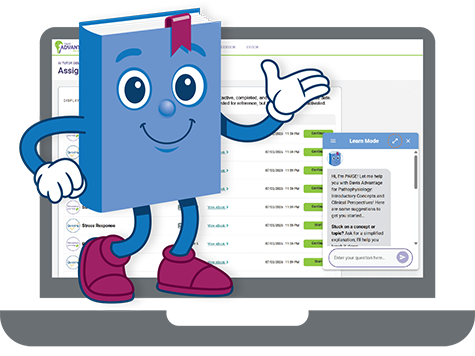
For Robbie, the goal is not to make learning as easy as possible. It is to use technology in a way that keeps students doing the thinking.
For Robbie, supporting better learning also means thinking about the people standing at the front of the classroom.
Many nursing educators come into teaching after working as nurses themselves. They bring years of clinical experience, but that does not necessarily mean they have been trained as educators.
“Many of our nurse educators do not necessarily have an education background. They’re nurses that are coming in from the hospital into a teaching environment, but they don’t necessarily have experience teaching.”
That has shaped what F.A. Davis thinks educators need from a publisher. The textbook is still at the centre, but it is increasingly surrounded by resources designed to help faculty understand how students are progressing and where they may need more support.
“So we’re trying to provide as many tools as we can to help with the faculty turnover that we’re seeing at many of these nursing schools.”
For Robbie, that is part of the publisher’s job too. Understanding what students need is only half of it. Publishers also need to understand the educators trying to teach them.
F.A. Davis has more than 300 active textbook titles today. In ten years, Robbie expects the company to focus on a handful of products that each span a whole nursing program.
“Our emphasis and focus will be on three to five products that are curriculum spanning, where we are providing a single solution that the student gains access to on day one of their nursing education, from the fundamentals of nursing all the way until they’re ready to take that licensure exam.”
Those products would still be built on the same carefully curated, expert-written and fact-checked content, organised online to follow whichever curriculum a program uses. Some US programs teach in a traditional sequence, starting with fundamentals and moving through medical-surgical nursing to specialties such as obstetrics, paediatrics and psychiatry. Others are concept-based and might cover oxygenation one week and elimination the next. The same content could be arranged to fit either path.
“Perhaps not a print textbook. But I’ve said it almost ad nauseam, the content is still king.”
For other publishers, the shift Robbie describes raises practical questions. How should content be organised when it has to work across different curricula? And what happens to the individual title when students buy access to a whole program from their first day?
Students have always looked for the quickest route to an answer, and Robbie admits he was no different in college. AI has made that shortcut much easier to take.
“We still can’t ignore the need for critical thinking. The educators still need to teach the students how to use AI effectively, so that they’re still making those connections in their brain. Because otherwise I think that natural tendency to simply want the answer as quickly as they can get it is not going to change.”
For publishers, that means designing AI that helps students move forward without doing the thinking for them, and supporting the educators who teach students when to use it.
Asked what he would like F.A. Davis to be known for in ten years, Robbie talks about the nurses it helps prepare.
“What F.A. Davis would like to be known for is the role we played in meeting the needs of both the students and the educators, to make sure that the best healthcare workers are the ones going into their fields, and that they’re prepared.”
His view gives publishers a useful test for everything they build, however advanced the technology becomes. Do students leave with the knowledge and judgment they will need once the course is over and the tools are gone?
We will continue sharing insights from leading voices across publishing and education. Subscribe to Letters from Ludenso on Substack to be notified when our next interview goes live.

